How each works
Supply chain finance
- A large buyer approves your invoice for payment.
- A bank or platform offers to pay you early, less a discount.
- The buyer pays the funder on the original due date.
Invoice finance
- You raise invoices to your customers.
- A funder advances a percentage of eligible invoices - up to 90% at Cashbook Finance, after approval and setup.
- The balance, less fees, follows when your customers pay.
Side by side
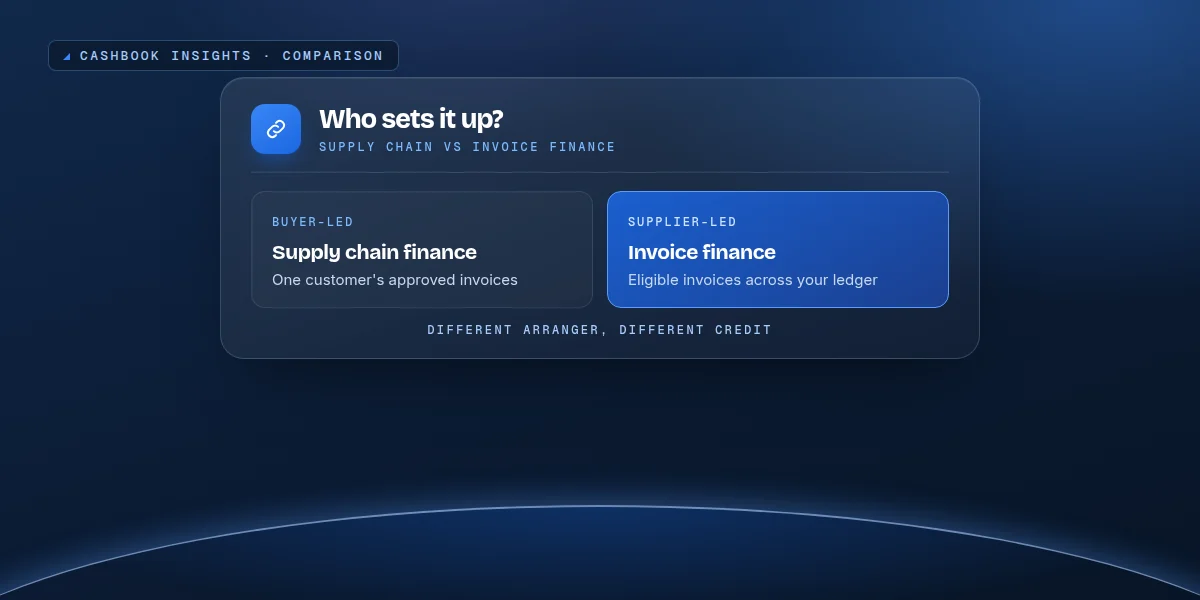
| Supply chain finance | Invoice finance | |
|---|---|---|
| Who arranges it | The buyer | Your business |
| Whose credit it relies on | The buyer’s | Your customers' and your business’s |
| Which invoices | Only that buyer’s approved invoices | Eligible invoices across your ledger (or selected ones) |
| Cost | Often low, reflecting the buyer’s credit | Reflects your ledger, customers and service level |
| Control | Set by the buyer’s programme | Set by your facility |
Which to use
- If a major customer offers a programme, it can be worth joining for that customer’s invoices.
- For the rest of your ledger, or if no programme exists, invoice finance gives you funding you control.
- If you need to pay suppliers before you can invoice, look at trade finance - compared in trade finance vs invoice finance.
Supply chain finance: a practical decision test
The question is not which product is better but which invoices each can fund. A buyer’s programme covers that buyer only; invoice finance covers the ledger you choose.
Commercial fit
Join a buyer’s programme where it is offered and good value; use invoice finance for every other customer.
Evidence and eligibility
Supply chain finance relies on the buyer approving each invoice; invoice finance looks at your customers, ledger quality and controls.
Operational fit
Check whether a programme restricts assigning that buyer’s invoices elsewhere, so the two arrangements do not conflict.
Alternatives
Trade finance for paying suppliers before you can invoice; selective invoice finance for occasional large invoices.
Supply chain finance: model the downside, not just the headline
Model your cash flow if the buyer changes or withdraws its programme; funding that depends on one customer’s choice can disappear at short notice.
Where this can go wrong
Joining a programme can tie a large customer’s invoices to one funder. Make sure an existing or planned invoice finance facility can exclude them cleanly.
Supply chain finance: questions to ask before signing
- Which customers' invoices would each arrangement cover?
- Does the buyer’s programme restrict assigning its invoices elsewhere?
- What does early payment cost compared with an invoice finance advance?
- What happens if the programme ends?
Supply chain finance: documents and controls to prepare
Every invoice finance discussion goes better with the same core pack: a current aged-debt report, representative contracts and invoices with delivery or acceptance evidence, recent management accounts with a short cash forecast, and an honest schedule of credit notes, bad debts and customer concentration. We keep one maintained resource covering the full pack, the questions that surface the all-in cost, and what to monitor once a facility is live - read the invoice finance preparation checklist.
This guide is general information, not a recommendation or an offer of finance.