

A current aged-debt report
Customer names, invoice dates, due dates, balances and disputed items clearly identified.
One maintained checklist for every invoice finance discussion: the documents that evidence your ledger, the questions that surface the all-in cost, and the controls that keep a live facility healthy.
Cash received · this invoice
A £50,000 invoice on 30-day terms
On a £50,000 invoice on 30-day terms: £45,000 advanced at 90%, £4,000 when your customer pays, a fee of about £1,000.
Illustrative: a 90% advance and a discount charge of about 2% of the invoice. Rates and advances vary by business, sector and customers.
Check eligibility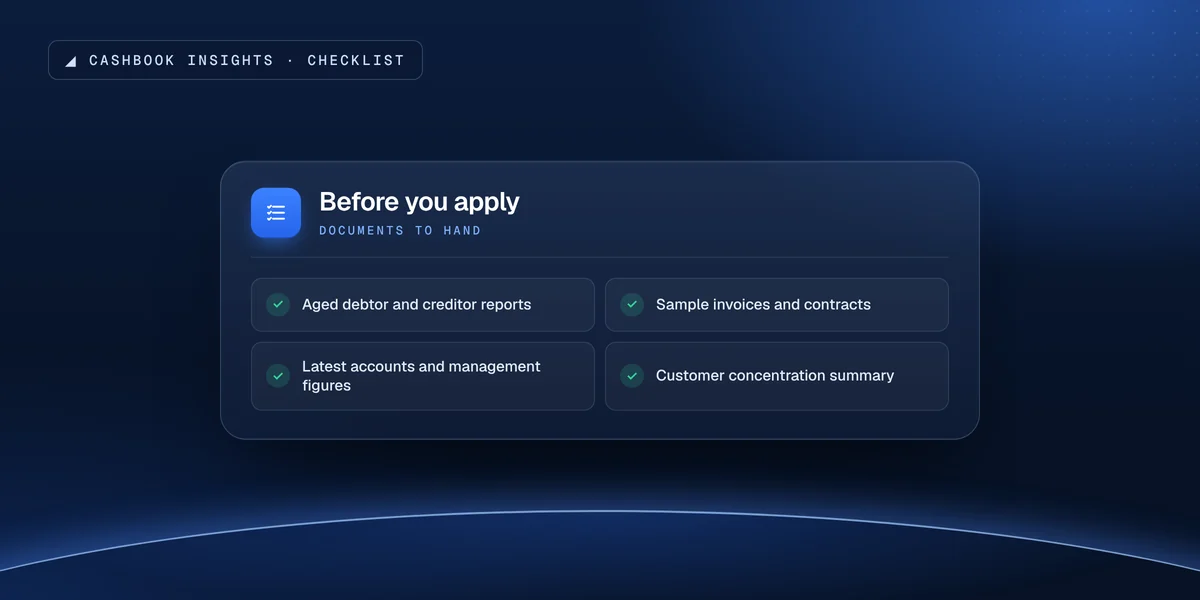
Before approaching a provider, assemble information that shows both the value of the receivables and the way the business controls them. A complete pack makes the discussion more useful and reduces the risk of comparing indicative terms that later change when the ledger is examined in detail.
Customer names, invoice dates, due dates, balances and disputed items clearly identified.
Together with purchase orders, signed timesheets, delivery notes or other evidence that the goods or services were accepted.
Showing why funding is required, the expected level of use and the route to lower reliance if trading weakens.
A schedule of each, plus an honest explanation of any unusual balances. Hiding exceptions only moves the problem into due diligence.
Model the downside, not just the headline. Ask for an all-in illustration at your expected utilisation - including service fees, discount charges, minimums, reserves and exit terms - then test a lower-sales case and a concentration case rather than relying on a headline rate.
Which invoices would be eligible, and what would reduce the available advance for your specific ledger and customers?
What does the facility cost at expected utilisation, including service fees, minimums, reserves, audit costs and exit terms?
Who owns customer communication, reporting, reconciliations and dispute escalation once the facility is live?
How does the facility behave if sales fall, a large debtor pays late, or invoice quality dips for a quarter?
A facility is healthy when the numbers behind it are. These are the controls we would expect any well-run borrower to keep.
Review availability and headroom every week, not only the bank balance. Track eligible debt, overdue invoices, disputes, dilution, concentration, average utilisation and the effective cost of funds.
Set those measures against gross margin and debtor days. Earlier cash should not be allowed to mask a deteriorating debtor book.
If the facility is being drawn more heavily while invoice quality or profitability deteriorates, stop treating the issue as a request for a higher limit and address the commercial cause.
Use the guide to organise the evidence and operating decision, not simply to compare product labels.
Amount, purpose, timing and why customer payment terms create the gap.
Aged debt, invoices, contracts, delivery evidence, credit notes and disputes.
Accounts, bank statements, payroll, existing finance and internal reporting controls.
Worked example
A business with a £120,000 sales ledger prepares its aged debtor report before applying.
Clearing old and disputed items before applying raises availability by more than the items themselves are worth to most lenders.
| Sales ledger (money customers owe you) | £120,000 |
|---|---|
| Less invoices over 90 days old | −£9,000 |
| Less disputed invoices | −£4,000 |
| Less the part of one customer above its concentration limit | −£0 |
| Eligible ledger | £107,000 |
| Available to draw at 85% | £90,950 |
| Available if the ledger were all eligible | £102,000 |
Illustrative: an 85% advance against eligible invoices. Eligibility rules, concentration limits and advance rates are set for each facility after review.
From Cashbook Finance’s perspective, the fastest initial reviews start with a reconciled aged-debtor ledger, representative invoices, evidence that goods or services have been delivered, customer terms, recent management information and a clear explanation of how the facility will be used. Missing evidence does not automatically mean a decline, but it creates questions that have to be resolved before availability can be relied on.
Official guidance and legislation on the rules this page refers to. They explain the rules in general; take advice on your own position.
A strong debtor ledger is boring in the best way: real B2B customers, clean evidence, sensible concentration and payment behaviour that can be explained.
Next step
A director reviews every application and gives a first view within one working day.