

- What invoice factoring is and how it works
- Costs, benefits and operational trade-offs
- Small-business fit and comparison with a loan
What is invoice factoring?
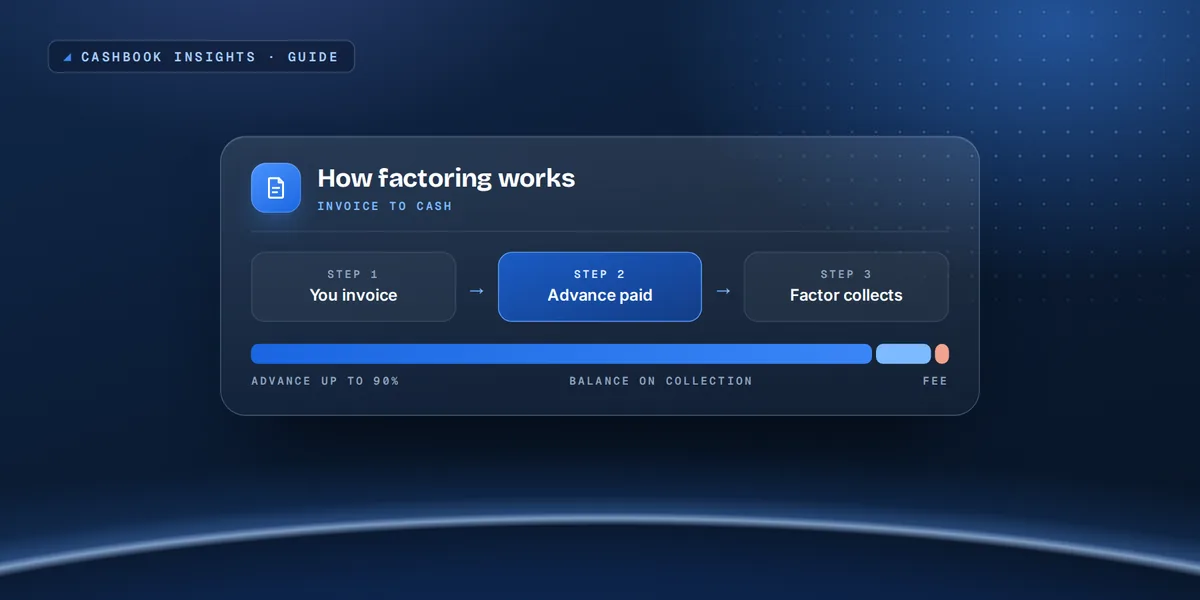
Invoice factoring is a form of invoice finance where a funder advances most of the value of an invoice as soon as you raise it – typically up to 90% within 24 to 48 hours – and releases the balance, minus a fee, once your customer pays. With factoring specifically, the funder also runs credit control: they chase and collect payment on your behalf, which lifts the admin of getting paid off your desk.
How the money flows
- You deliver the goods or service and raise an invoice as normal.
- You upload the invoice to the funder – often automatic from your accounting software.
- The advance (up to 90%) lands in your account, usually within a day or two.
- Your customer pays on their normal terms; the funder collects.
- The balance is released to you, less the agreed fee.
What does it cost?
There are two straightforward parts: a service fee for running the facility (a small percentage of turnover) and a discount charge on the funds you actually draw, a little like interest. Both are agreed in plain terms up front. Factoring is typically dearer than secured bank debt – but the honest comparison is like-for-like, including the value of having collections handled for you.
Is factoring right for your business?
It tends to suit UK SMEs that sell to other businesses on credit terms, invoice after delivery, and have a spread of creditworthy customers. It works best when the paperwork is clean – order, delivery, invoice – and it is especially powerful for businesses that are growing, seasonal, or simply cash-tight despite being profitable. It fixes when cash arrives, not whether – so it complements a healthy business rather than rescuing a failing one.
Where factoring earns its place
Factoring is useful when the commercial problem is timing: the business has completed the work, raised valid B2B invoices and needs cash before customers reach their normal payment date. The facility converts a changing ledger into a revolving source of working capital and can remove the day-to-day burden of collections.
Cash-flow timing
Funding can arrive soon after an eligible invoice is raised, helping payroll, suppliers, tax and growth expenditure move on schedule rather than waiting for debtor terms.
Credit control
With factoring, the provider normally manages collection. That can strengthen discipline and free internal time, but the customer-contact model should be agreed before signing.
Growth capacity
Availability can rise as eligible sales rise. That is often more useful for recurring working-capital needs than a fixed loan that does not automatically follow turnover.
Ledger visibility
Regular reconciliation, concentration monitoring and dispute reporting make debtor quality visible; weak paperwork reduces availability.
Is factoring suitable for a small business?
Size is not the decisive test. A smaller business can be a strong fit when it sells to creditworthy businesses, invoices after delivery, keeps clear evidence and has enough margin to absorb the all-in cost. It is weaker where invoices are consumer-facing, conditional, heavily disputed or concentrated in one fragile customer.
Turning accounts receivable into cash
The receivable remains linked to the underlying sale. The funder advances against eligible debt, collects or receives the customer payment and releases the remaining balance after agreed charges and any reserves. It is not the same as selling poor or uncollectable debt.
Factoring vs a business loan
A loan provides a fixed amount and fixed repayment obligation. Factoring is revolving and tied to eligible invoices. Factoring often fits recurring cash-flow gaps and growth; a term loan can be better for a defined one-off asset or project with a clear repayment budget. Compare total cost, security, covenants, customer communication and what happens when sales fall.
Start with the problem, not the brochure
A useful factoring decision starts with the commercial problem, not the product brochure. Define the amount of working capital required, how long the need will last, which invoices will support it and what improvement the business expects. That prevents a technically available facility from becoming an expensive default source of cash.
Commercial fit
Check sales are B2B, invoiced after delivery, with healthy margins and creditworthy customers. The facility should scale with good sales, not rely on disputed or overdue debts.
Evidence and eligibility
Prepare customer contracts, aged debt, credit-note history, management accounts and proof of delivery. Providers assess invoice quality and controls because they drive collectability.
Operational fit
Document the process from invoice to collection and cash allocation. Decide who contacts customers, how disputes escalate and how often the ledger is reconciled.
Alternatives
Compare factoring with discounting, selective finance, an overdraft and a loan. Recurring needs favour a revolving facility; a one-off asset may not.
Ask for an all-in illustration
Ask for an all-in illustration using your expected utilisation. Include service fees, discount charges, minimums, audit costs, reserves and exit terms. Then test a lower-sales case and a concentration case rather than relying on the provider’s headline example.
Where this can go wrong
Factoring can mask a deteriorating debtor book for a period because cash arrives earlier. Monitor disputes, debtor days, dilution and concentration every month. If those indicators worsen, the answer is stronger commercial control, not simply a larger limit.
Questions to ask a factoring provider
- Which invoices would be eligible, and what would reduce the available advance for evaluating an invoice-factoring facility?
- What is the all-in cost at expected utilisation, including minimums, reserves and exit terms?
- Who owns customer communication, reporting, reconciliations and dispute escalation?
- How does the facility behave if sales fall or the largest debtor pays late?
Preparing your factoring application
Every invoice finance discussion goes better with the same core pack: a current aged-debt report, representative contracts and invoices with delivery or acceptance evidence, recent management accounts with a short cash forecast, and an honest schedule of credit notes, bad debts and customer concentration. We keep one maintained resource covering the full pack, the questions that surface the all-in cost, and what to monitor once a facility is live – read the invoice finance preparation checklist.
This guide is general information, not a recommendation or an offer of finance. Suitability, availability, pricing and terms depend on the business, the debtor ledger and the proposed structure.