The essentials
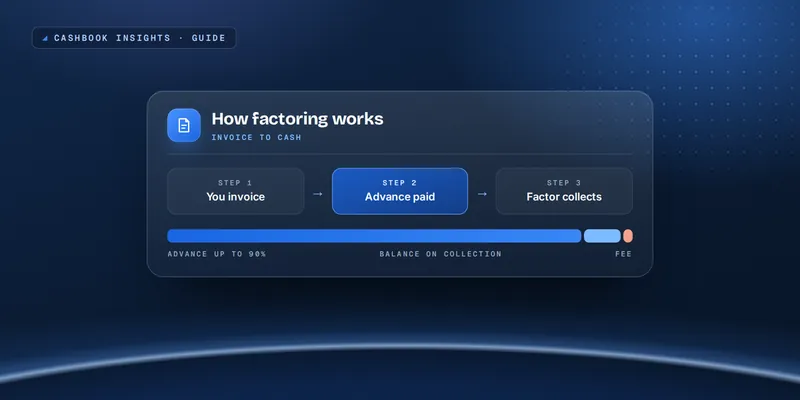
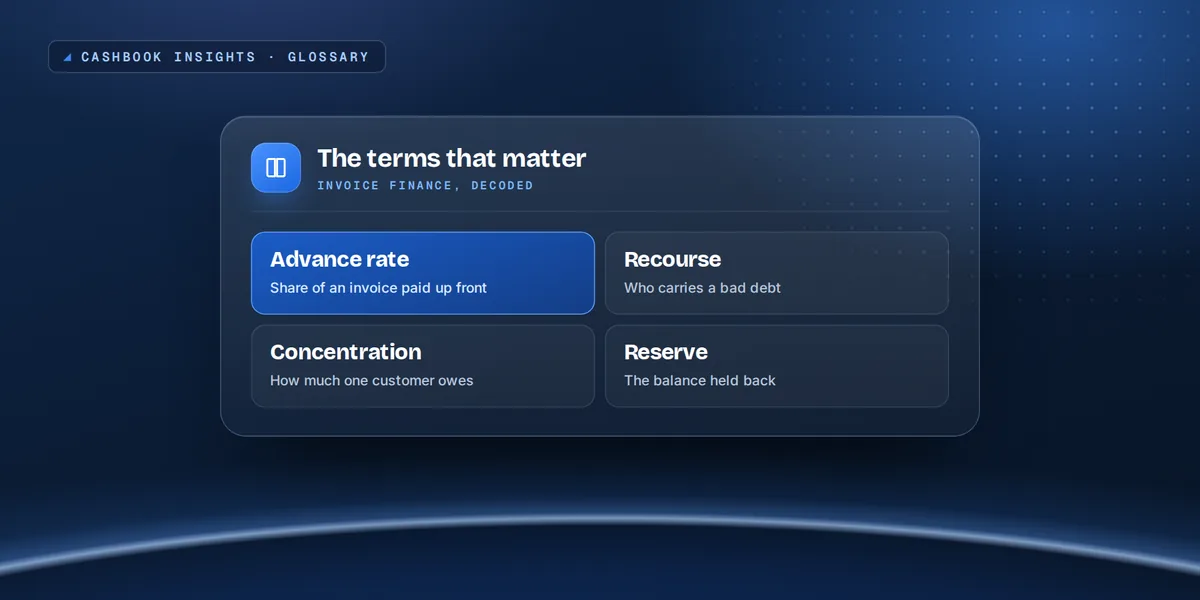
- Advance rate - the percentage of an invoice paid to you upfront, commonly up to 90%.
- Service fee - a percentage of turnover for running the facility.
- Discount charge - a charge on the funds you actually draw, similar to interest.
- Recourse - if a customer doesn’t pay within an agreed period, the advance on that invoice reverses to you.
- Non-recourse - the funder carries the risk if a customer becomes insolvent (usually for an extra fee).
A few more you’ll meet
- Eligible debt - invoices that meet the facility rules and can contribute to funding availability.
- Borrowing base - the value of eligible receivables after exclusions, reserves and concentration rules are applied.
- Dilution - reductions to invoice value caused by credit notes, returns, rebates, disputes or other adjustments.
- Reserve - an amount held back from the headline advance to reflect risk, eligibility or expected adjustments.
- Aged-debt report - a ledger report showing unpaid invoices by customer and how long each balance has been outstanding.
- Debtor concentration - the share of the ledger represented by one customer or connected customer group.
- Debtor credit limit - the maximum amount of a customer’s debt that the funder is prepared to treat as eligible.
- Recourse period - the period after which an unpaid funded invoice may become ineligible or be charged back to the business.
- Minimum term - the contractual period for which a facility is expected to remain in place.
- Notice period - the advance notice required to terminate or materially change a facility.
- Collect-out - the process of allowing funded invoices to be collected and balances settled when a facility is ending.
- Reconciliation - the regular matching of invoices, collections, credit notes and funding availability to the sales ledger.
- Disclosed vs confidential - whether your customers are told a funder is involved.
- Notice of Assignment - the notice telling a customer to pay the funder (in disclosed facilities).
- Concentration limit - a cap on how much funding one large customer can represent.
- Selective / single-invoice - funding chosen invoices rather than the whole ledger.
- Verification - a light check that an invoice relates to genuine, delivered work.
Specialist terms
- Applications for payment - in construction, a contractor’s claim for work done in a period, which is valued and certified before it becomes payable. Read the guide to construction invoice finance.
- CHOCs (client handles own collections) - a disclosed facility where the business, not the funder, chases payment. Read the guide to CHOCs.
- CIS deduction - tax withheld under the Construction Industry Scheme from payments to subcontractors; funders lend against the net amount. Read the guide to construction invoice finance.
- Contra / set-off - where a customer reduces payment by an amount it says you owe it.
- Credit insurance - insurance against specified customers becoming insolvent or failing to pay, within limits. Read the guide to recourse and non-recourse finance.
- Credit note - a document reducing an invoice’s value; frequent credit notes reduce funding availability.
- Debtor days (DSO) - the average number of days customers take to pay.
- Facility limit - the maximum funding available under a facility, whatever the ledger supports.
- Prepayment - another word for the initial advance against an invoice.
- Retention - part of a construction payment held back until completion or the end of the defects period; usually not funded. Read the guide to construction invoice finance.
- Supply chain finance (reverse factoring) - early payment of approved invoices arranged by a large buyer. Read the guide to supply chain finance.
Knowing these makes comparing quotes far easier - and if a provider can’t explain a charge in plain terms, that tells you something too. For property-backed lending, see the bridging finance glossary.
Invoice finance: a practical decision test
Terminology matters because similar-sounding terms can change the economics or control of a facility. “Advance rate” is not the same as cash available, “confidential” does not mean invisible in every circumstance, and a low discount margin does not represent the total cost. Definitions should be tied to the contract and worked examples.
Commercial fit
Translate every term into an operational consequence: who contacts customers, when an invoice becomes ineligible, what triggers a reserve and when fees are charged. If the team cannot explain the mechanics plainly, it is not ready to manage the facility.
Evidence and eligibility
Ask the provider to apply key definitions to a sample aged-debt report. That exposes how concentration, ageing, disputes and credit limits affect availability more clearly than a glossary alone.
Operational fit
Create a short internal guide for finance and sales staff covering eligible invoices, notification requirements, credit notes and collection responsibilities. Consistent language reduces reporting errors.
Alternatives
When two offers use different terminology, normalise them into the same cash-flow model. Compare usable funds, total charges, service scope and termination obligations rather than matching labels.
Invoice finance: model the downside, not just the headline
Request a month-by-month example showing opening debt, new invoices, collections, reserves, fees and closing availability. Recalculate it independently. A transparent provider should be able to explain every movement.
Where this can go wrong
Ambiguous terms become expensive when the business assumes the most favourable interpretation. Do not rely on sales conversations for critical points. Make sure concentration limits, recourse, minimums and exit costs are explicit in the documents.
Invoice finance: questions to ask before signing
- Which invoices would be eligible, and what would reduce the available advance for reading invoice-finance terms correctly?
- What is the all-in cost at expected utilisation, including minimums, reserves and exit terms?
- Who owns customer communication, reporting, reconciliations and dispute escalation?
- How does the facility behave if sales fall or the largest debtor pays late?
Invoice finance: documents and controls to prepare
Every invoice finance discussion goes better with the same core pack: a current aged-debt report, representative contracts and invoices with delivery or acceptance evidence, recent management accounts with a short cash forecast, and an honest schedule of credit notes, bad debts and customer concentration. We keep one maintained resource covering the full pack, the questions that surface the all-in cost, and what to monitor once a facility is live - read the invoice finance preparation checklist.
This guide is general information, not a recommendation or an offer of finance. Suitability, availability, pricing and terms depend on the business, the debtor ledger and the proposed structure.