

Interest, arrangement fee, valuation, legal work, possible exit/admin charges and any broker fee should be viewed together.
Cost guide · bridging financeFCA-registered UK lender FRN 782472 (opens the FCA register in a new tab)
Bridging costs explained.
This is a practical guide to total bridging cost. It explains interest, arrangement fees, valuation and legal costs, exit fees, loan-to-value, term length, security quality and why the cheapest headline rate can still be the wrong deal.
Read aloud by your browser
Bridging structure check
A £325,000 loan against a £500,000 property
65%
loan-to-value, against a 70% illustrative reference point
- Equity remaining
- £175,000
- Headroom to 70% LTV
- £25,000
Within a 70% illustrative LTV reference point.
A £325,000 loan against a £500,000 property is 65% loan-to-value; equity remaining £175,000.
Security risk: Your property may be repossessed if you do not keep up repayments on a loan secured against it.
LTV, asset type, title risk, borrower profile, exit route, term, urgency and documentation quality all affect cost.
Estimating true total cost, comparing quotes properly and avoiding open-ended borrowing that gets expensive fast.
Decision guide
What actually changes bridging cost.
More equity and valuation margin usually improve the case.
A credible sale or refinance route lowers uncertainty.
Open-ended borrowing creates avoidable cost.
| Cost driver | Usually stronger when | Watch-out |
|---|---|---|
| Loan-to-value | More equity and valuation margin usually improve the case. | Tight LTV leaves no room for cost or value movement. |
| Exit route | A credible sale or refinance route lowers uncertainty. | Speculative exits are expensive or not fundable. |
| Legal route | Clean title and fast solicitors help completion. | Title defects, planning issues and unclear ownership slow everything. |
| Timing | Short, documented deadlines can fit bridging well. | Open-ended borrowing creates avoidable cost. |
Decision framework
Bridging costs: use the comparison to make a funding decision.
Separate headline interest from the full cost of completing and exiting the bridge.
Interest
May be serviced, rolled or retained. The method changes net proceeds.
Transaction costs
Valuation, legal, arrangement and broker costs can materially affect the usable amount.
Delay risk
Extensions, default interest or a delayed exit can increase total cost beyond the initial illustration.
Examples are educational only. Eligibility, pricing, security and final terms always depend on a formal assessment of your business, your documents and the facility proposed.
Worked example
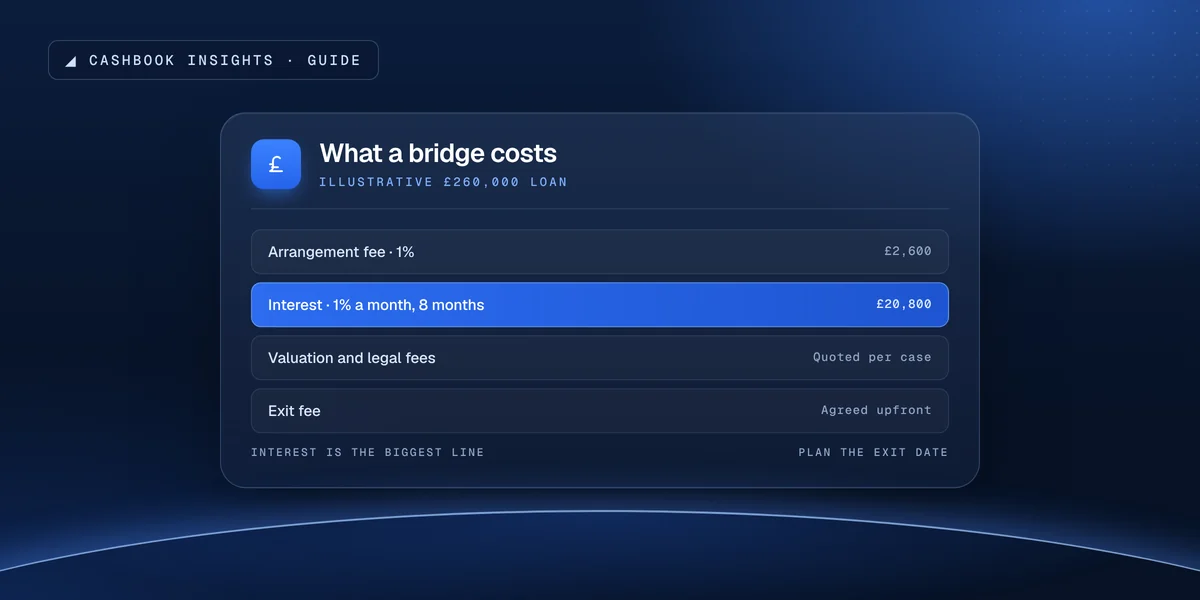
The full cost of a bridge.
A £325,000 bridge against a £500,000 property (the console above), repaid by a sale in month 9.
Interest is the largest cost and grows with every month the exit takes, which is why the exit date matters more than the headline rate.
| Property value | £500,000 |
|---|---|
| Gross loan (65% loan-to-value) | £325,000 |
| Arrangement fee, 1%, from the loan | £3,250 |
| Interest at 1% a month, rolled up, for 9 months | £29,250 |
| Repaid at exit (loan plus interest) | £354,250 |
| Cost before valuation and legal fees | £32,500 |
| If the exit is 3 months late | +£9,750 in interest |
Illustrative: interest at 1% a month, rolled up, and an arrangement fee of 1% of the loan. Valuation and legal costs are extra and quoted per case. Bridging finance is secured against property, which may be repossessed if repayments are not maintained.
Cashbook Finance perspective
What actually drives bridging-finance cost?
Cashbook Finance assesses the whole repayment case rather than one monthly rate. Loan-to-value, property type and condition, valuation, legal complexity, expected term, retained or serviced interest, borrower circumstances and the credibility of the exit all affect structure and total cost. A faster or higher-leverage transaction can require more risk headroom even when the underlying property is strong.
Official sources
- Bank Rate (opens in a new tab)Bank of England
Official guidance and legislation on the rules this page refers to. They explain the rules in general; take advice on your own position.
Next step
Ready to check the numbers on your case?
A director reviews every application and gives a first view within one working day.