

Usually a service fee and discount charge, sometimes with setup, audit or minimum fees depending on the facility.
Cost guide · invoice financeFCA-registered UK lender FRN 782472 (opens the FCA register in a new tab)
Invoice finance costs explained.
The moving parts behind invoice finance pricing are the service fee, discount charge, debtor quality, ledger behaviour, concentration risk and evidence quality. This guide explains each, so you know what a quote is actually charging for. It is a cost guide, not a rate card.
Read aloud by your browser
Cash received · this invoice
A £50,000 invoice on 30-day terms
- Invoice value
- £50,000
- Paid to you, day 1–2
- £45,000
- When your customer pays
- £4,000
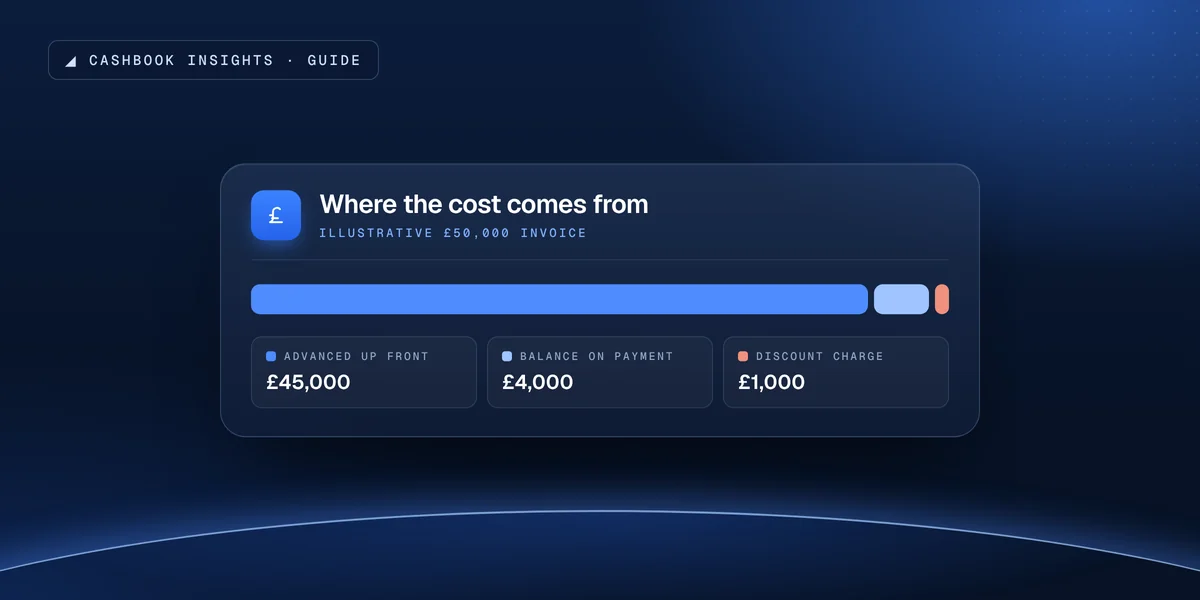
On a £50,000 invoice on 30-day terms: £45,000 advanced at 90%, £4,000 when your customer pays, a fee of about £1,000.
Illustrative: a 90% advance and a discount charge of about 2% of the invoice. Rates and advances vary by business, sector and customers.
Check eligibilityDebtor strength, invoice age, dilution risk, volume, sector, contract evidence and ledger discipline all move pricing.
Reading quote terms, spotting expensive structures and knowing what to improve before applying.
Decision guide
What actually changes invoice finance cost.
Established customers with clear payment history usually strengthen pricing.
Clean delivery evidence and low disputes improve the case.
Comparing headline rates without service scope is misleading.
| Cost driver | Usually stronger when | Watch-out |
|---|---|---|
| Debtor quality | Established customers with clear payment history usually strengthen pricing. | Weak, concentrated or hard-to-contact debtors increase risk. |
| Invoice evidence | Clean delivery evidence and low disputes improve the case. | Missing proof, credit notes and disputes can reduce availability. |
| Facility use | Regular, predictable use is easier to price. | Irregular emergency use is usually harder to assess. |
| Service level | Factoring support and protection features affect total cost. | Comparing headline rates without service scope is misleading. |
Decision framework
Invoice finance costs: use the comparison to make a funding decision.
A complete cost view separates the service fee, discount charge and case-specific costs.
Service fee
Usually linked to turnover or invoices processed and the service level provided.
Discount charge
Accrues on funds actually drawn, commonly by time outstanding.
Other costs
May include setup, audit, legal, minimum-use or specific transaction costs; terms must state them clearly.
Examples are educational only. Eligibility, pricing, security and final terms always depend on a formal assessment of your business, your documents and the facility proposed.
Cashbook lending perspectiveThe cheapest headline rate is not necessarily the cheapest facility once availability, service fees, minimums and actual drawdown are considered.Related guidance:Invoice finance · Pricing & decisions · Case studies
Worked example
What one invoice actually costs.
A £50,000 invoice on 30-day terms, funded at 90%.
The charge is about the time the money is out, so the same invoice costs twice as much if the customer takes twice as long.
| Invoice value, on 30-day terms | £50,000 |
|---|---|
| Advanced within 24–48 hours (90%) | £45,000 |
| Discount charge, about 2% per 30 days, for 30 days | £1,000 |
| Paid to you when your customer pays | £4,000 |
| Total cost of funding this invoice | £1,000 (2% of the invoice) |
| If your customer pays 30 days late | +£1,000 in charges |
Illustrative: up to 90% advanced and a discount charge of about 2% of the invoice per 30 days. Rates, advances and any service fee vary by business, sector and customers, and are confirmed in writing before you commit.
Cashbook Finance perspective
What actually drives invoice-finance pricing?
Cashbook Finance looks beyond a headline percentage. Pricing and availability are shaped by debtor quality, concentration, invoice values, payment terms, dilution or disputes, service level, expected utilisation and the amount of operational work required to manage the facility. The cheapest-looking rate is not necessarily the lowest total cost if availability is weak or collections deteriorate.
Official sources
- Bank Rate (opens in a new tab)Bank of England
Official guidance and legislation on the rules this page refers to. They explain the rules in general; take advice on your own position.
Next step
Ready to check the numbers on your case?
A director reviews every application and gives a first view within one working day.