

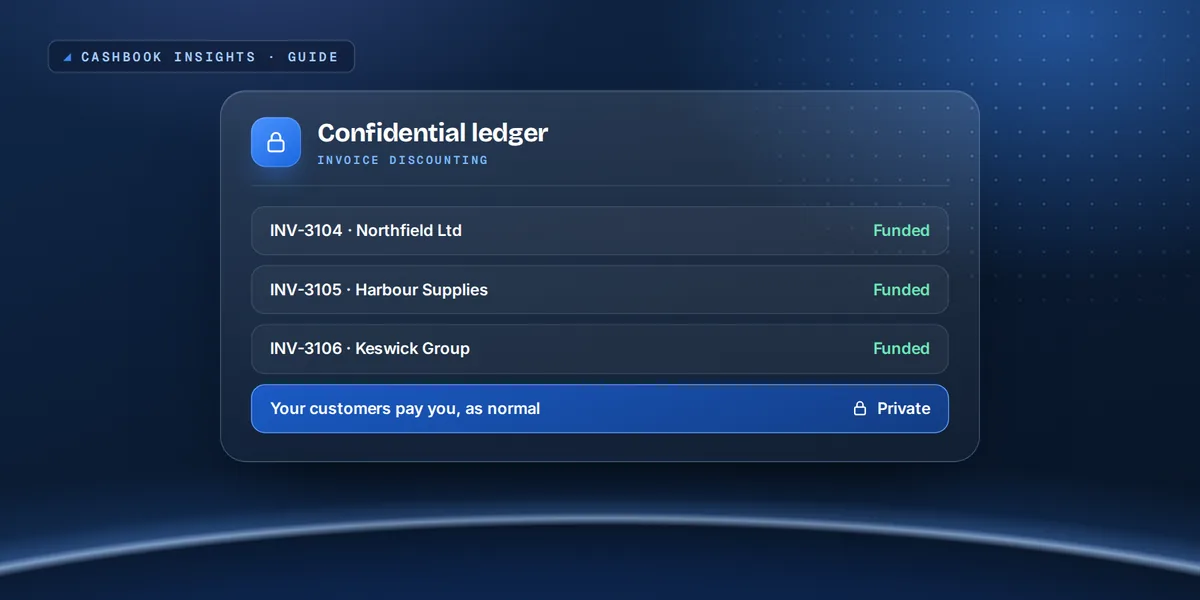
How it works
You raise invoices as normal and the funder makes a percentage of their value – commonly up to 90% – available to draw straight away. You continue to collect payment from your customers yourself. As customers pay, the facility revolves, and you can keep drawing against new invoices.
Confidentiality is the headline benefit
Discounting is usually confidential: your customers see no change and need never know a funder is involved. You keep your own credit control and customer contact, which is why discounting tends to suit businesses with their own finance function and reliable collections.
Discounting vs factoring
The key difference is who chases payment. With discounting you keep that in-house; with factoring the funder does it for you. Discounting is typically a little cheaper as a result, but it assumes you have the systems to manage collections well.
Is it right for you?
As a guide, funders look for UK SMEs selling B2B on credit terms, with reliable credit control and a minimum turnover of around £50,000 – though every business is assessed on its own merits.
Confidentiality needs disciplined credit control
Invoice discounting is not simply factoring without customer contact. It assumes the business can maintain disciplined credit control, accurate reporting and a clean ledger while using the receivables as security. Confidentiality has value only if the finance team can operate the facility reliably.
Commercial fit
It suits established B2B businesses with robust systems, low disputes and experienced collections. If credit control is inconsistent, a disclosed service with more support may fit better.
Evidence and eligibility
Providers review management accounts, aged debt, dilution, bad-debt history, concentration and ledger controls. Reconciliations matter because availability is calculated from your data.
Operational fit
Assign ownership for daily postings, monthly reconciliations, availability reporting and covenant monitoring. Confidential facilities fail operationally when responsibility is spread across people who assume someone else is checking the ledger.
Alternatives
Compare discounting with factoring, an overdraft and selective finance. The correct choice depends less on secrecy and more on who should control collections, how predictable the ledger is and whether funding is needed continuously.
Calculate the net usable advance
Calculate the net usable advance after reserves, concentration restrictions, minimum fees and seasonal movements. Test whether the business still has enough headroom when several invoices are aged out or become disputed.
Where this can go wrong
The key risk is inaccurate or delayed ledger reporting. Overstated availability can create a sudden repayment requirement when the position is corrected. Strong controls are not administrative overhead; they are part of the credit proposition.
Questions on eligibility, reserves and reporting
- Which invoices would be eligible, and what would reduce the available advance for choosing confidential invoice discounting?
- What is the all-in cost at expected utilisation, including minimums, reserves and exit terms?
- Who owns customer communication, reporting, reconciliations and dispute escalation?
- How does the facility behave if sales fall or the largest debtor pays late?
Preparing for a confidential facility
Every invoice finance discussion goes better with the same core pack: a current aged-debt report, representative contracts and invoices with delivery or acceptance evidence, recent management accounts with a short cash forecast, and an honest schedule of credit notes, bad debts and customer concentration. We keep one maintained resource covering the full pack, the questions that surface the all-in cost, and what to monitor once a facility is live – read the invoice finance preparation checklist.
This guide is general information, not a recommendation or an offer of finance. Suitability, availability, pricing and terms depend on the business, the debtor ledger and the proposed structure.