

Releases cash against eligible B2B invoices and can rise or fall with turnover.
Funding comparison · decision guideFCA-registered UK lender FRN 782472 (opens the FCA register in a new tab)
Invoice finance vs overdraft.
Choose invoice finance when completed work is unpaid. Use an overdraft when you need a smaller general buffer. You are comparing a sales-led facility against a bank credit limit. Use this page to see which works when the cash gap is caused by slow-paying customers, seasonal pressure, or a need for a general safety buffer.
Read aloud by your browser
Cash received · this invoice
A £50,000 invoice on 30-day terms
- Invoice value
- £50,000
- Paid to you, day 1–2
- £45,000
- When your customer pays
- £4,000
On a £50,000 invoice on 30-day terms: £45,000 advanced at 90%, £4,000 when your customer pays, a fee of about £1,000.
Illustrative: a 90% advance and a discount charge of about 2% of the invoice. Rates and advances vary by business, sector and customers.
Check eligibilityA bank-agreed credit limit for broader cashflow pressure, reviewed around credit appetite and account conduct.
Choose invoice finance when completed work is unpaid. Use an overdraft when you need a smaller general buffer.
Decision guide
Invoice finance or an overdraft: the practical difference.
Invoice finance is based on eligible B2B invoices and debtor quality.
Useful where customers pay reliably but slowly.
The bank can reduce or withdraw facilities, often when pressure is highest.
| Question | Usually stronger when | Watch-out |
|---|---|---|
| Funding basis | Invoice finance is based on eligible B2B invoices and debtor quality. | An overdraft is a general bank limit and may not rise with sales. |
| Best use | Useful where customers pay reliably but slowly. | Useful for smaller day-to-day timing swings. |
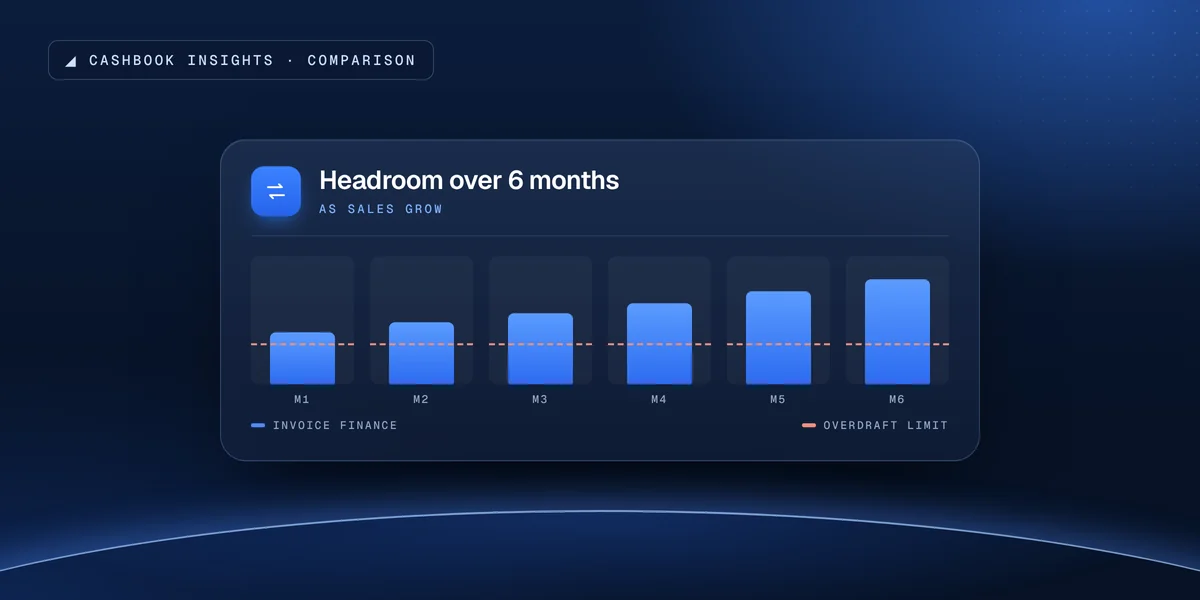
| Scaling | Availability can increase as the ledger grows. | The limit may stay fixed even when turnover rises. |
| Watch-out | Weak debtors or disputed invoices reduce availability. | The bank can reduce or withdraw facilities, often when pressure is highest. |
Worked example
Covering a seasonal peak.
A seasonal business invoices £40,000 in its busy month on 45-day terms. Its overdraft limit is fixed at £15,000.
The advance rises with the invoices raised; the overdraft would cover less than half of the gap.
| Invoice value, on 45-day terms | £40,000 |
|---|---|
| Advanced within 24–48 hours (90%) | £36,000 |
| Discount charge, about 2% per 30 days, for 45 days | £1,200 |
| Paid to you when your customer pays | £2,800 |
| Total cost of funding this invoice | £1,200 (3% of the invoice) |
| If your customer pays 15 days late | +£400 in charges |
Illustrative: up to 90% advanced and a discount charge of about 2% of the invoice per 30 days. Rates, advances and any service fee vary by business, sector and customers, and are confirmed in writing before you commit.
Decision framework
Invoice finance or an overdraft: use the comparison to make a funding decision.
Compare committed structure, renewal risk and how availability is calculated.
Funding base
Invoice finance is linked to eligible receivables; an overdraft is a bank limit.
Review
Both can be reviewed, but overdrafts are often renewed periodically and can be reduced.
Operations
Invoice finance needs ledger controls; an overdraft is simpler day to day but may not grow with sales.
Examples are educational only. Eligibility, pricing, security and final terms always depend on a formal assessment of your business, your documents and the facility proposed.
Can invoice finance replace an overdraft?
For gaps caused by slow customers it often can, because it grows with your invoices. Some businesses keep a small overdraft for day-to-day swings.
Is invoice finance more expensive?
The charge per pound can be higher, but you only pay for the days you use it and the limit grows with sales.
Can a bank reduce an overdraft?
Yes, overdrafts are usually reviewed and can be reduced or withdrawn.
Do I need to change bank?
No. Invoice finance works alongside your existing bank account.
Next step
Ready to check the numbers on your case?
A director reviews every application and gives a first view within one working day.