

Supports supplier, stock or import/export timing before the final customer has paid.
Funding comparison · decision guideFCA-registered UK lender FRN 782472 (opens the FCA register in a new tab)
Trade finance vs invoice finance.
Trade finance and invoice finance sit at different points in the transaction. One helps fund the purchase or supply of goods before sale; the other releases cash after invoices have been raised.
Read aloud by your browser
Cash received · this invoice
A £50,000 invoice on 30-day terms
- Invoice value
- £50,000
- Paid to you, day 1–2
- £45,000
- When your customer pays
- £4,000
On a £50,000 invoice on 30-day terms: £45,000 advanced at 90%, £4,000 when your customer pays, a fee of about £1,000.
Illustrative: a 90% advance and a discount charge of about 2% of the invoice. Rates and advances vary by business, sector and customers.
Check eligibilityReleases cash from completed sales once an eligible invoice has been raised.
If the pressure is before sale, assess trade finance. If the pressure is after sale, assess invoice finance.
Decision guide
Trade finance or invoice finance: the practical difference.
The right comparison is not simply the lowest headline rate. Match the facility to the asset being funded, the evidence available, the expected duration, the operational work required and the event that repays it. A cheaper product used for the wrong job can create more delay, covenant pressure or refinancing risk than a correctly structured specialist facility.
Trade finance sits before or during the buying cycle.
Supplier invoices, customer orders and margin evidence matter.
Invoices without delivery evidence or debtor strength are weak.
| Question | Usually stronger when | Watch-out |
|---|---|---|
| Timing | Trade finance sits before or during the buying cycle. | Invoice finance sits after delivery and invoicing. |
| Evidence | Supplier invoices, customer orders and margin evidence matter. | Debtor quality, invoice validity and delivery evidence matter. |
| Repayment | Often repaid when goods are sold and customer invoices settle. | Repaid from customer collections on funded invoices. |
| Watch-out | Speculative stock without demand is weak. | Invoices without delivery evidence or debtor strength are weak. |
Worked example
One order, both stages.
An importer buys £40,000 of goods, sells them 45 days later for £52,000 and gives its customer 30 days to pay.
Trade finance covers the gap before the sale; invoice finance takes over once the invoice is raised.
| Supplier paid up front by trade finance | £40,000 |
|---|---|
| Trade finance fee, about 2% (example) | £800 |
| Customer invoice once goods are delivered | £52,000 |
| Advanced against that invoice (90%), repaying the trade finance | £46,800 |
| Discount charge on the invoice, 30 days | £1,040 |
| Your margin after both charges | £10,160 |
Illustrative: a trade finance fee of about 2% for the 45 days before sale (as the trade finance page assumes), then a 90% invoice advance and a discount charge of about 2% per 30 days.
Decision framework
Trade finance or invoice finance: use the comparison to make a funding decision.
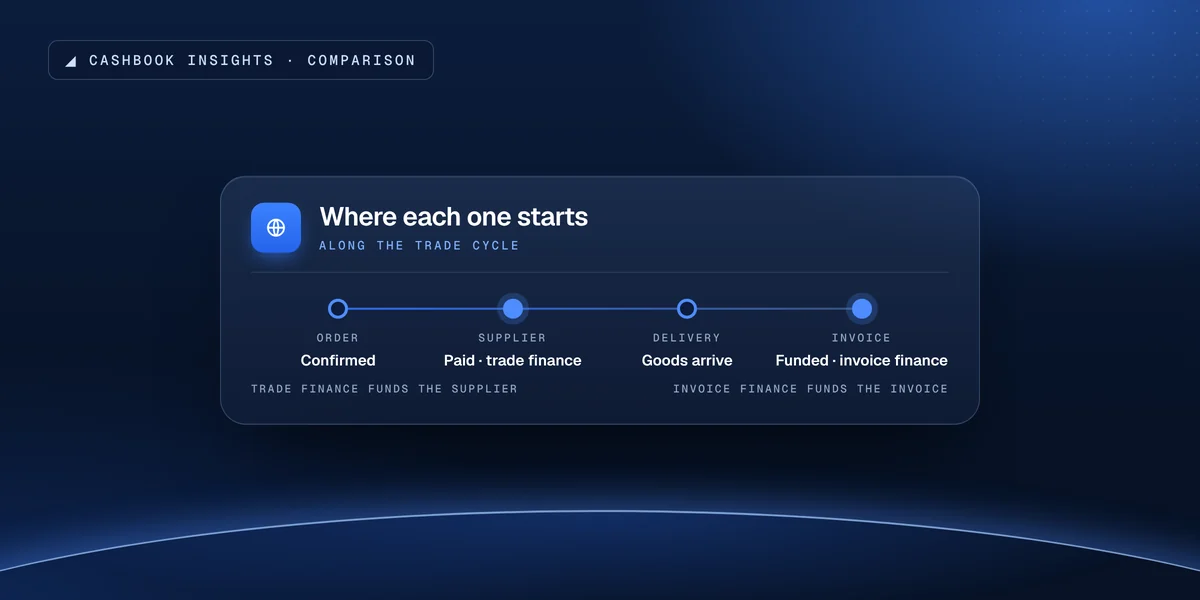
The facilities start at different points in the commercial cycle.
Before delivery
Trade finance can pay an approved supplier against a verified order or transaction.
After delivery
Invoice finance can release cash after eligible goods or services are delivered and invoiced.
Repayment
Trade finance is repaid from the transaction proceeds; invoice finance reduces when the debtor pays.
Examples are educational only. Eligibility, pricing, security and final terms always depend on a formal assessment of your business, your documents and the facility proposed.
Can I use both on the same order?
Yes. Trade finance pays the supplier; once you invoice your customer, invoice finance can repay it.
Does trade finance fund speculative stock?
Generally not. It is strongest against a confirmed customer order with a clear margin.
Which documents are needed?
Supplier invoices, the customer order, shipping and delivery evidence and the margin.
Is trade finance only for importers?
No. It supports any business that must pay suppliers before it is paid.
Official sources
Official guidance and legislation on the rules this page refers to. They explain the rules in general; take advice on your own position.
Next step
Ready to check the numbers on your case?
A director reviews every application and gives a first view within one working day.