

What "recourse" means
Invoice finance advances cash against invoices you have raised. The question recourse answers is simple: if the customer does not pay, who absorbs the loss?
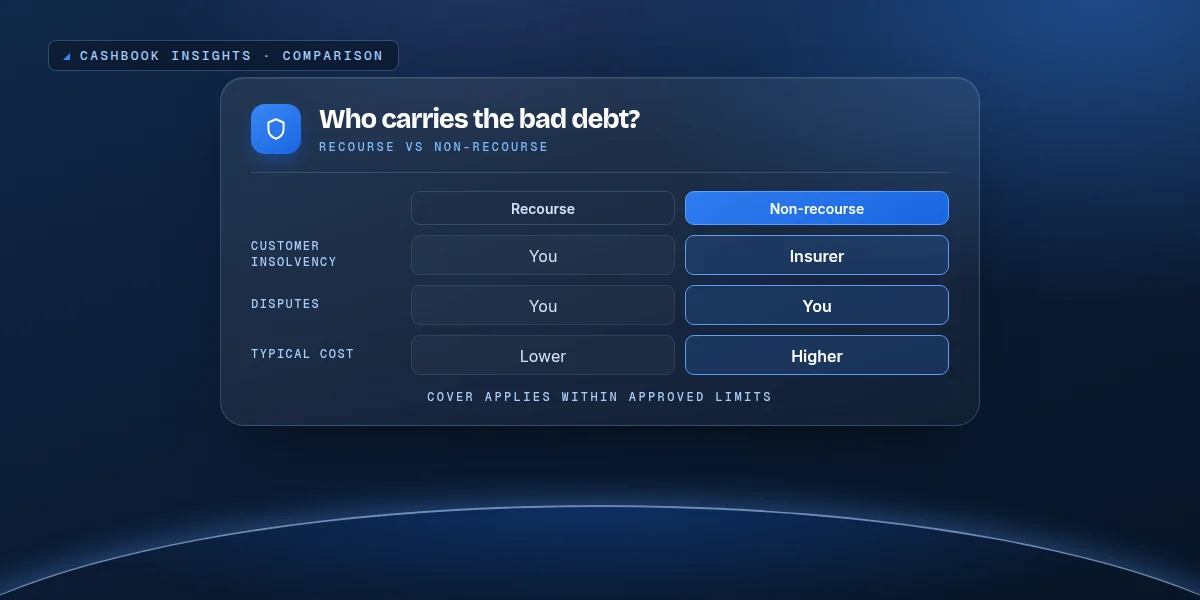
- Recourse: you do. After an agreed recourse period (commonly measured from the invoice due date), an unpaid invoice stops counting towards your funding, and the advance against it is repaid or deducted from future availability.
- Non-recourse: the funder, or more often a credit insurer behind the facility, carries the loss if an approved customer becomes insolvent, up to an agreed credit limit and subject to the policy terms.
What non-recourse cover usually does not cover
Non-recourse is not a guarantee that every invoice will be paid. Typical exclusions include:
- Disputes. If the customer says the goods or work were faulty, late or not as ordered, that is a dispute, not a bad debt.
- Customers above their credit limit. Cover applies up to the limit set for each customer; anything above it is at your risk.
- Slow payment that is not insolvency. A customer who is simply late is a collections issue.
- Late notification. Policies usually require overdue accounts to be reported within set time limits.
How the cost compares
Recourse facilities are generally cheaper, because the funder takes less risk. Non-recourse or credit-insured arrangements add a cost for the cover, which depends on the customers, their limits, your sector and your claims history. The right comparison is the all-in cost against the risk you would otherwise carry. Read invoice finance costs explained for the moving parts of pricing.
Side by side
| Recourse | Non-recourse / credit-insured | |
|---|---|---|
| Who carries a customer’s insolvency | Your business | The insurer or funder, within approved limits |
| Typical cost | Lower | Higher (includes the cover) |
| Disputes and slow payers | Your risk | Still your risk |
| Best for | Spread ledgers of reliable, established customers | Concentrated ledgers, or customers whose failure would hurt badly |
How to choose
- Look at concentration. If one or two customers are a large share of your ledger, their failure is the risk to insure.
- Check what you already have. Some businesses already hold trade credit insurance; it may be possible to use it.
- Read the limits, not the headline. Cover is only as useful as the credit limits on the customers you actually trade with.
- Price the downside. Compare the cost of cover against what one large bad debt would do to your cash flow.
At Cashbook Finance, invoice finance facilities can be arranged with bad-debt protection alongside, subject to approved customer limits, policy terms and exclusions.
Which risk can you afford to keep?
Choosing between recourse and non-recourse is a decision about which risk you can afford to keep. Compare the cost of cover with the damage one large customer failure would do, not just the headline fee.
Commercial fit
Non-recourse cover earns its cost when one or two customers dominate the ledger or one failure would hit payroll.
Evidence and eligibility
Insurers set a credit limit for each customer. Check those limits against your real exposures before relying on cover.
Operational fit
Cover usually needs overdue accounts reported on time and disputes handled promptly.
Alternatives
A wider spread of customers, tighter credit terms or existing trade credit insurance can reduce the need for cover.
Model your largest customer failing
Model what happens if your largest customer fails: the advance against its invoices, the recourse period, and the cash you would need to repay. Then compare that with the annual cost of cover.
Where this can go wrong
Non-recourse cover does not protect against disputes, slow payers or customers above their approved limit. Treat it as insolvency protection within limits, not a guarantee of payment.
Questions on credit limits, recourse periods and exclusions
- Which customers would have credit limits, and at what level?
- What is the recourse period, and what happens to funding when it ends?
- What does the cover exclude, and what are the notification deadlines?
- What is the all-in cost of cover at expected turnover?
Preparing for a credit-protected facility
Every invoice finance discussion goes better with the same core pack: a current aged-debt report, representative contracts and invoices with delivery or acceptance evidence, recent management accounts with a short cash forecast, and an honest schedule of credit notes, bad debts and customer concentration. We keep one maintained resource covering the full pack, the questions that surface the all-in cost, and what to monitor once a facility is live – read the invoice finance preparation checklist.
This guide is general information, not a recommendation or an offer of finance.