

Working capitalFCA-registered UK lender FRN 782472 (opens the FCA register in a new tab)

Working capital: 5 advantages that keep your business moving

Working capital – the cash available to meet day-to-day costs – is the lifeblood of any business. When it’s healthy, everything runs more smoothly; when it’s stretched, even profitable firms come under pressure. Here are five advantages of keeping it strong.

Not sure yet? Check eligibility in 2–3 minutes, or talk to a director.

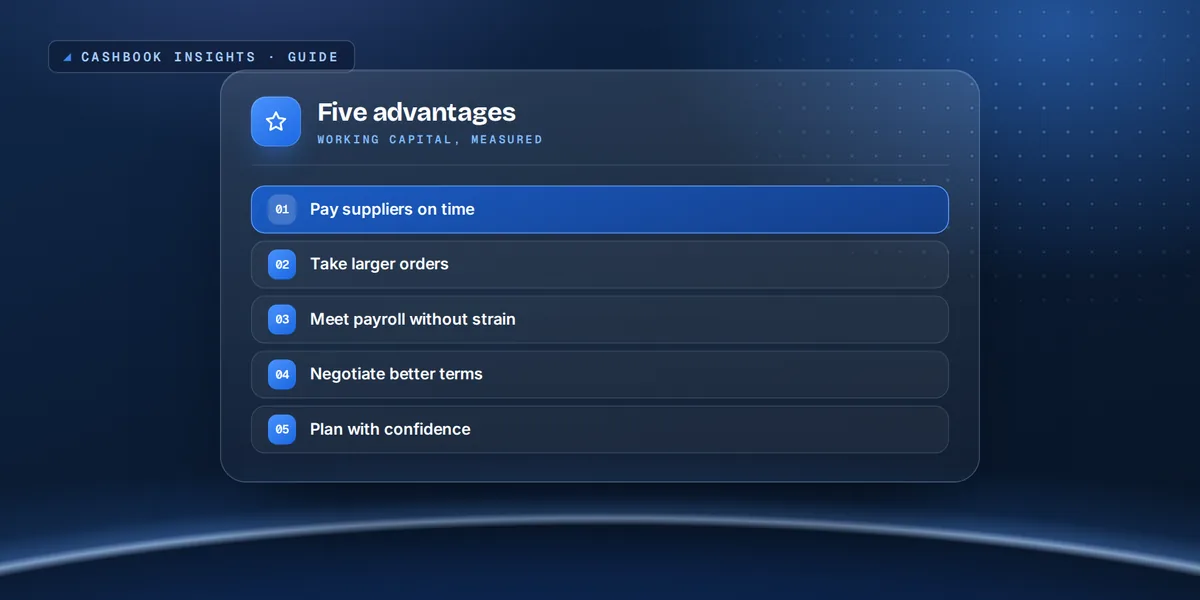
Five working capital advantages, from paying suppliers on time to planning with confidence

Worked example

Working capital released from one month’s sales.

A business invoices £80,000 a month on 60-day terms, so about £160,000 is owed to it at any time.

Repeated each month, the advance turns two months of waiting into a few days.

Working capital released from one month’s sales.: the figures
Invoice value, on 60-day terms£80,000
Advanced within 24–48 hours (90%)£72,000
Discount charge, about 2% per 30 days, for 60 days£3,200
Paid to you when your customer pays£4,800
Total cost of funding this invoice£3,200 (4% of the invoice)

Illustrative: up to 90% advanced and a discount charge of about 2% of the invoice per 30 days. Rates, advances and any service fee vary by business, sector and customers, and are confirmed in writing before you commit. Try your own figures in the calculator.

  1. You always meet your obligations – wages, suppliers, rent and tax are paid on time, protecting relationships and reputation.
  2. You can seize opportunities – a big order or a bulk-buy discount becomes a yes, not a missed chance.
  3. You’re resilient to shocks – a late-paying customer or a quiet month doesn’t tip you into crisis.
  4. You negotiate from strength – paying suppliers promptly often earns better terms and discounts.
  5. You can grow on your own terms – expansion is funded steadily rather than through panic borrowing.

How invoice finance protects working capital

The most common drain on working capital is cash tied up in unpaid invoices. Invoice finance releases up to 90% of that money within 24 to 48 hours, and because it grows with your sales, it keeps working capital healthy precisely when growth would otherwise stretch it thinnest. The stage-by-stage funding guide explains how that relationship changes as the business matures.

Working capital is the whole cycle

Working capital is not just the cash balance. It is the interaction of receivables, inventory, payables and operating commitments. Invoice finance improves one part of that cycle. The benefit is strongest when management also controls stock, supplier terms and billing discipline.

Commercial fit

Use it where receivables absorb cash and earlier collection supports profitable trading. It won’t fund slow-moving stock or pre-revenue development.

Evidence and eligibility

Track debtor days, eligible debt, concentration, credit notes and overdue invoices, alongside payable days and stock.

Operational fit

Set rules for how released cash is used. Prioritise obligations and growth investments that improve contribution, rather than allowing every department to treat availability as extra budget.

Alternatives

Improve billing frequency, deposits, stock purchasing and supplier terms before increasing borrowing. Finance should complement working-capital management, not replace it.

Build an integrated cash forecast

Build an integrated cash forecast rather than a receivables-only model. Include facility costs, VAT, payroll and supplier peaks. Measure minimum headroom under slower collections and lower sales.

Where this can go wrong

Earlier cash can hide deteriorating conversion elsewhere in the cycle. If inventory or overhead grows faster than gross profit, the facility will be drawn more heavily without improving resilience.

Questions on protecting working capital

  1. Which invoices would be eligible, and what would reduce the available advance for protecting working capital with invoice finance?
  2. What is the all-in cost at expected utilisation, including minimums, reserves and exit terms?
  3. Who owns customer communication, reporting, reconciliations and dispute escalation?
  4. How does the facility behave if sales fall or the largest debtor pays late?

Preparing a working-capital review

Every invoice finance discussion goes better with the same core pack: a current aged-debt report, representative contracts and invoices with delivery or acceptance evidence, recent management accounts with a short cash forecast, and an honest schedule of credit notes, bad debts and customer concentration. We keep one maintained resource covering the full pack, the questions that surface the all-in cost, and what to monitor once a facility is live – read the invoice finance preparation checklist.

This guide is general information, not a recommendation or an offer of finance. Suitability, availability, pricing and terms depend on the business, the debtor ledger and the proposed structure.

Cash conversion

Working capital needs numbers, not slogans.

The page now connects the operating cycle to measurable debtor, inventory and supplier days – and shows how a change in those days affects cash.

DSODays sales outstanding: how long credit sales remain unpaid.
DIODays inventory outstanding: how long cash remains tied up in stock.
DPODays payable: how long you take to pay suppliers.
CCCCash conversion cycle = DIO + DSO − DPO.

Numerical example

A business has £3.65 million annual credit sales, so each debtor day represents about £10,000. Reducing debtor days from 58 to 46 releases roughly £120,000, assuming sales remain stable.

£3,650,000 ÷ 365 = £10,000 sales per day(58 − 46) × £10,000 = £120,000 released

If inventory days rise by ten days at the same time, part of the cash benefit may be absorbed elsewhere in the cycle.

Match the tool to the blockage

  • Invoice finance: when cash is tied up in valid B2B receivables.
  • Overdraft or revolving credit: when the timing need is broader and fluctuates independently of invoices.
  • Term loan: when a defined investment can support fixed repayments.
  • Supplier or stock finance: when the primary blockage occurs before the sale or invoice.
Match the tool to the blockage
ProblemMeasureOperational responseFinance question
Customers pay slowlyDSO, overdue %, disputesImprove billing, approval and collections.Can valid receivables support a revolving facility?
Too much stockDIO, ageing, write-offsReduce slow-moving lines and improve forecasting.Is the need genuinely temporary and order-backed?
Suppliers paid too earlyDPO, discount termsRenegotiate terms without damaging supply.Would finance cost less than lost supplier discounts?
Growth absorbs cashCCC and peak cash needModel the full contract or seasonal cycle.Does funding expand with profitable sales or create fixed strain?
Practical implementation

Translate working capital into measurable operating outcomes

Use the guide to organise the evidence and operating decision, not simply to compare product labels.

01

Payroll resilience

Measure whether available cash covers the real wage date, not only the month-end balance.

03

Growth capacity

Model the extra delivery cost and debtor delay created by each new contract.

Next step

Turn working capital into usable cash

Tell us your sales, terms and debtor days, and a director will show what could be released.

Start an application

Not sure yet? Check eligibility in 2–3 minutes, or talk to a director.