

Funding against invoices
A factor advances cash against approved B2B invoices and usually manages collections. Availability can grow with the ledger. Customer quality, disputes, concentration and evidence of delivery matter.
Both can release cash, but they are built on different assets and repaid in different ways. The right comparison is not “which is cheaper?” in isolation - it is which structure matches the purpose, evidence and cash cycle.
Cash received · this invoice
A £50,000 invoice on 30-day terms
On a £50,000 invoice on 30-day terms: £45,000 advanced at 90%, £4,000 when your customer pays, a fee of about £1,000.
Illustrative: a 90% advance and a discount charge of about 2% of the invoice. Rates and advances vary by business, sector and customers.
Check eligibility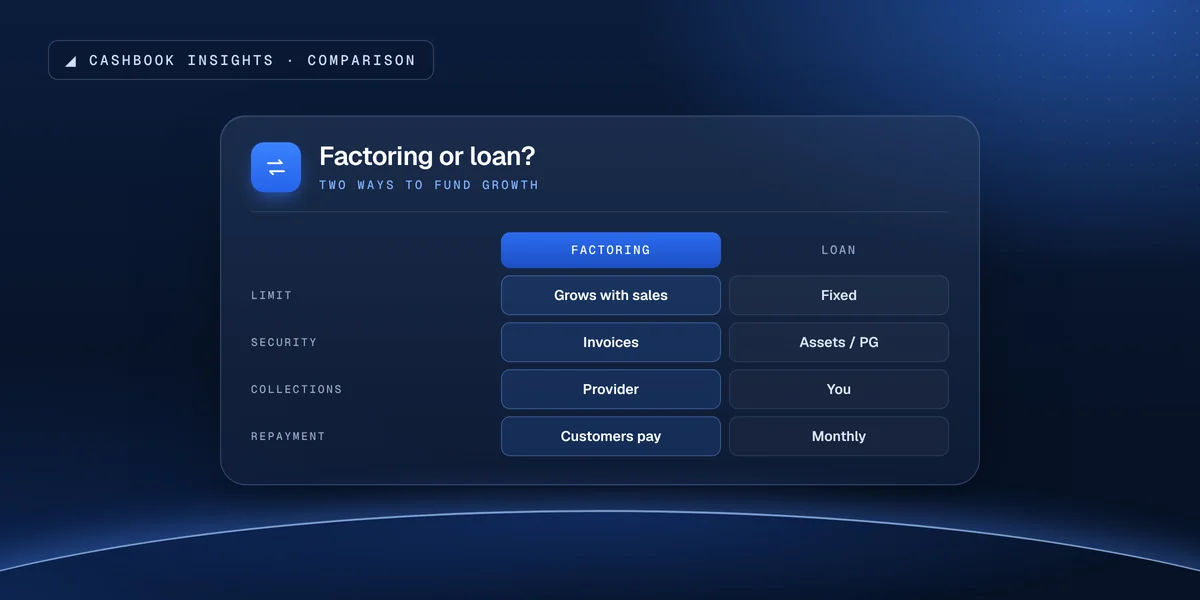
A factor advances cash against approved B2B invoices and usually manages collections. Availability can grow with the ledger. Customer quality, disputes, concentration and evidence of delivery matter.
A loan provides a set amount repaid under an agreed schedule. The lender assesses affordability, trading performance, credit history, security and the purpose of the borrowing.
Factoring can suit recurring B2B sales on credit terms. A loan may fit a defined investment with predictable repayment capacity.
Factoring availability can move with invoicing. A loan is usually fixed and may require a new application to increase it.
Compare the full service, discount charge, arrangement fees, loan interest, security costs and the operational value of collections - not one headline rate.
The page now separates the two products by funding base, repayment behaviour and operating burden rather than relying on generic pros-and-cons.
| Decision point | Invoice factoring | Business loan |
|---|---|---|
| Best aligned to | Cash already earned through completed B2B invoices. | A defined investment or general-purpose capital requirement. |
| Funding base | Eligible receivables, debtor quality, concentration and collectability. | Business affordability, credit profile, security and sometimes a personal guarantee. |
| Repayment behaviour | Customer payments reduce the funded balance; new eligible invoices may create fresh availability. | Capital and interest are repaid on an agreed schedule. |
| Operational burden | Requires ledger reporting, invoice verification and disciplined credit control. | Usually lighter day-to-day reporting once the loan is drawn. |
| Customer visibility | Factoring is normally disclosed because the provider handles collections. | Customers are normally unaffected by the borrowing arrangement. |
| Failure mode | Availability contracts if invoices become disputed, concentrated, overdue or ineligible. | Fixed repayments can strain cash flow if trading weakens. |
A business has a £400,000 eligible debtor ledger. At an illustrative 80% advance, gross availability would be £320,000 before reserves, fees and any ineligible balances.
£400,000 eligible ledger × 80% = £320,000 gross availabilityA £320,000 business loan may provide the same headline capital, but it creates a fixed repayment obligation rather than availability that revolves with invoice collections.
Educational comparison. The example is not a quote or recommendation. Actual availability, pricing, security and repayment terms depend on assessment and the final agreement.
Worked example
A contractor needs about £35,000 now and has a £40,000 invoice due in 60 days.
The factoring cost ends when the customer pays; a loan of the same size keeps its repayments running whether customers pay or not.
| Invoice value, on 60-day terms | £40,000 |
|---|---|
| Advanced within 24–48 hours (90%) | £36,000 |
| Discount charge, about 2% per 30 days, for 60 days | £1,600 |
| Paid to you when your customer pays | £2,400 |
| Total cost of funding this invoice | £1,600 (4% of the invoice) |
Illustrative: up to 90% advanced and a discount charge of about 2% of the invoice per 30 days. Rates, advances and any service fee vary by business, sector and customers, and are confirmed in writing before you commit.
This comparison needs to separate funding from the collections service included with factoring.
Factoring releases cash against eligible receivables; a loan provides fixed borrowing.
Factoring commonly includes disclosed credit control and collections support.
Factoring reduces as debtors pay; a loan uses scheduled repayments regardless of invoice collections.
Next step
A director reviews every application and gives a first view within one working day.