

The invoices are not fundable
Invoices need to be valid, owed by businesses, evidenced and usually undisputed. Old, unclear or disputed debt is not the same as working capital.
Most weak applications fail for boring reasons: the invoices are not clean enough, the debtor book is not strong enough, or the business is asking invoice finance to solve the wrong problem.
Cash received · this invoice
A £50,000 invoice on 30-day terms
On a £50,000 invoice on 30-day terms: £45,000 advanced at 90%, £4,000 when your customer pays, a fee of about £1,000.
Illustrative: a 90% advance and a discount charge of about 2% of the invoice. Rates and advances vary by business, sector and customers.
Check eligibility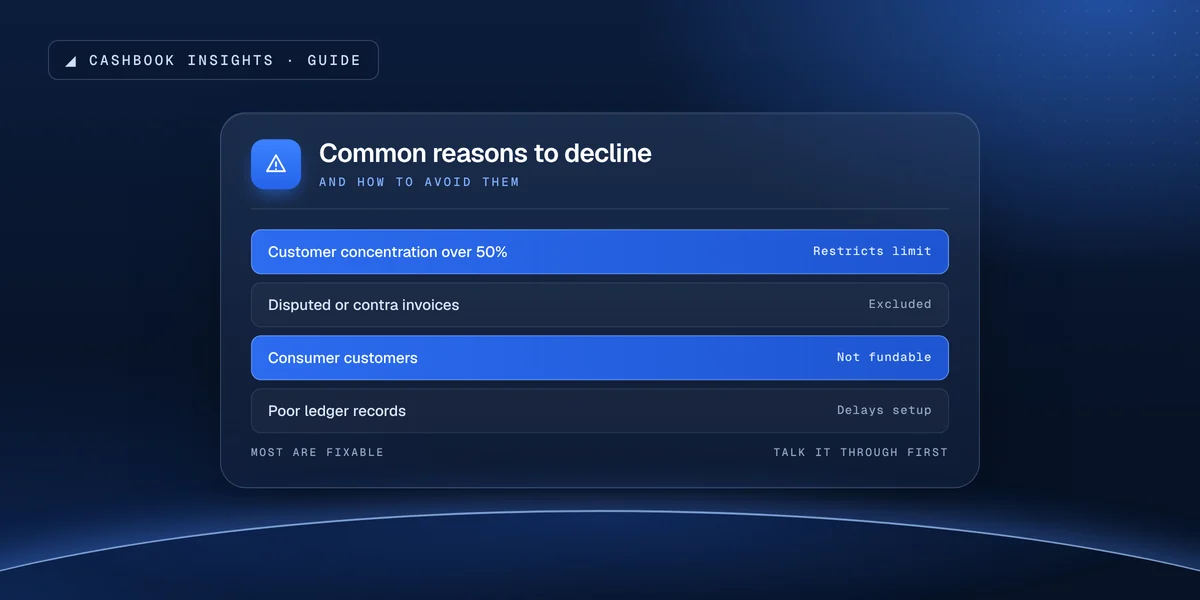
In Cashbook Finance reviews, an invoice-finance application is more likely to stall or be declined when the underlying debt is conditional, disputed, poorly evidenced or concentrated in customers that cannot support the requested facility. Weak reporting, persistent dilution and uncertainty over whether invoices are genuinely due can matter more than headline turnover.
This reflects recurring factors in Cashbook Finance underwriting and case reviews. It is general information, not an approval promise or a substitute for assessment of a specific application.
Use this before applying. If the weak point is obvious, solve it before asking for terms.
Invoices need to be valid, owed by businesses, evidenced and usually undisputed. Old, unclear or disputed debt is not the same as working capital.
A ledger with one dominant customer can still work, but only if payment history, contract evidence and customer quality support it.
If cash is needed for a one-off unrelated cost, a loan, bridge or different structure may be more honest than invoice finance.
Applications are often weakened by consumer sales, disputed work, overdue debt, concentrated customers, weak delivery evidence or a requirement that is unrelated to the receivable cycle. None of those points is improved by presenting a bigger turnover figure without explaining the ledger underneath it.
A better application identifies which invoices are genuinely eligible, why customers pay when they do, what causes credits or disputes and how the facility will be used. Where the ledger is not yet fundable, the useful answer is a specific remediation plan rather than a vague invitation to try again later.
Worked example
A £100,000 ledger in which one customer owes £55,000 (the limit is 40% of the ledger) and older invoices have built up.
Most declines and low offers trace back to a few items like these, which can often be fixed before applying.
| Sales ledger (money customers owe you) | £100,000 |
|---|---|
| Less invoices over 90 days old | −£14,000 |
| Less disputed invoices | −£6,000 |
| Less the part of one customer above its concentration limit | −£15,000 |
| Eligible ledger | £65,000 |
| Available to draw at 85% | £55,250 |
| Available if the ledger were all eligible | £85,000 |
Illustrative: an 85% advance against eligible invoices. Eligibility rules, concentration limits and advance rates are set for each facility after review.
A decline is usually about the quality or enforceability of the funding base, not simply turnover.
Uncompleted work, disputes, retentions or conditional payment weaken eligibility.
An unreconciled ledger or unexplained credit notes make availability unreliable.
Poor margin, concentration, existing security or no credible use of funds can prevent a workable structure.
Official guidance and legislation on the rules this page refers to. They explain the rules in general; take advice on your own position.
Most weak invoice-finance applications fail before pricing. The issue is usually debtor quality, evidence, concentration or a business trying to fund something that is not really invoice-led.
Next step
A director reviews every application and gives a first view within one working day.