

Clear B2B debtors
Invoices to established businesses are easier to fund than consumer sales or hard-to-verify customers.
A strong ledger is not just a high sales number. It is a pattern of clean invoices owed by customers that can be verified and usually pay.
Cash received · this invoice
A £50,000 invoice on 30-day terms
On a £50,000 invoice on 30-day terms: £45,000 advanced at 90%, £4,000 when your customer pays, a fee of about £1,000.
Illustrative: a 90% advance and a discount charge of about 2% of the invoice. Rates and advances vary by business, sector and customers.
Check eligibility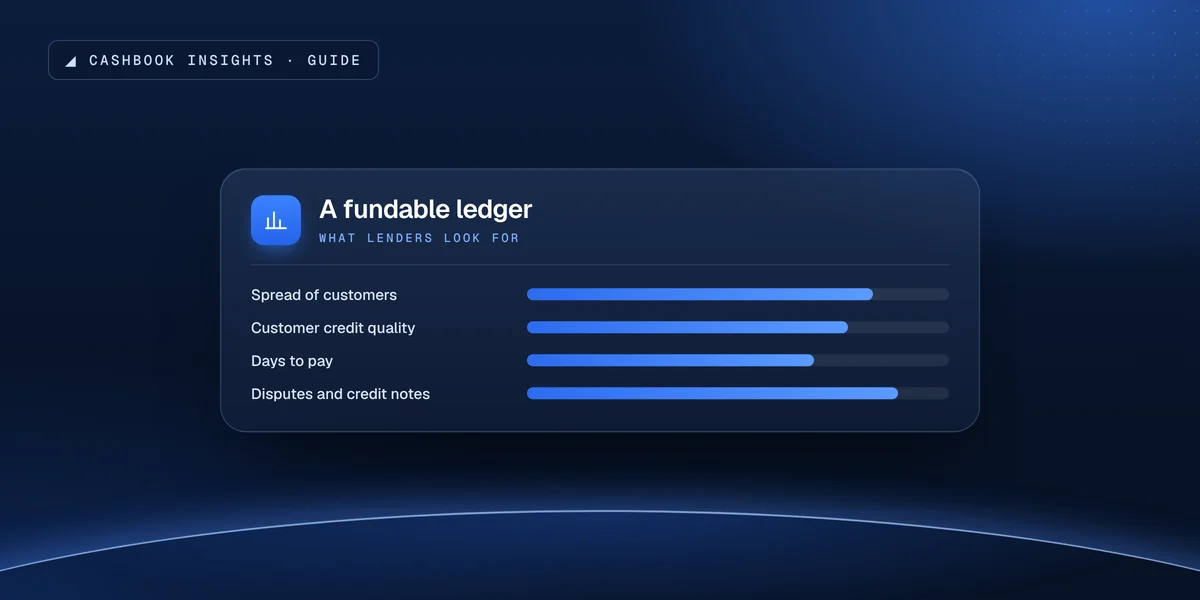
Use this before applying. If the weak point is obvious, solve it before asking for terms.
Invoices to established businesses are easier to fund than consumer sales or hard-to-verify customers.
A ledger with clean delivery evidence and few credit notes is more reliable than one with constant adjustments.
Lenders care about whether the ledger performs month after month, not just the latest large invoice.
A large ledger is not automatically a strong ledger. Quality comes from customers who can be identified, contacted and expected to pay against completed, evidenced work. Low dispute levels, consistent credit-note behaviour and a spread of established B2B debtors usually matter more than one impressive headline balance.
Preparation should reconcile the aged debt report to the accounting records, explain overdue items and separate retentions, contra arrangements, related-party balances and invoices still subject to acceptance. That gives the lender a realistic view of what can be advanced and what should remain outside the facility.
When Cashbook Finance reviews a debtor ledger for invoice finance, size alone is not enough. We look for valid and evidenced invoices, debtor quality, payment behaviour, concentration, disputes, credit notes and reporting that reconciles to the underlying trade. A smaller, cleaner ledger can be more fundable than a larger ledger with weak evidence or concentrated risk.
This reflects recurring factors in Cashbook Finance underwriting and case reviews. It is general information, not an approval promise or a substitute for assessment of a specific application.
A ledger is not attractive because it is large. It is attractive when the debts are valid, collectible, diversified enough and controlled by reliable reporting.
Financial strength, payment history, sector exposure and whether the debtor can set off other claims.
How much of the ledger depends on the largest debtor and whether that exposure is stable or rising.
Completed work, contractual entitlement, delivery evidence, approval and absence of material dispute.
Current balances, overdue trends, old debt and whether extensions are becoming normal.
Credit notes, returns, rebates, contra, retentions and other reductions from invoice face value.
Ledger reconciliation, audit trail, collections discipline and the speed at which exceptions are identified.
| Area | Maximum | Example score | Reason |
|---|---|---|---|
| Debtor quality | 25 | 21 | Established payers with stable history. |
| Concentration | 20 | 12 | Largest debtor represents 42% of the ledger. |
| Invoice validity | 20 | 18 | Strong delivery evidence; minor approval delays. |
| Ageing | 15 | 11 | Some balances beyond agreed terms. |
| Dilution | 10 | 7 | Regular credits average 3% of invoices. |
| Reporting control | 10 | 8 | Monthly reconciliation; exceptions not yet weekly. |
| Total | 100 | 77 | Potentially workable, but concentration needs a control. |
Important. This scorecard is an educational framework, not Cashbook Finance’s approval model and not a guarantee of availability.
Worked example
A £150,000 sales ledger in which one customer owes £75,000, against a concentration limit of 40% of the ledger (£60,000).
Spread, current and undisputed invoices are what make a ledger attractive; one dominant or slow customer reduces what can be drawn.
| Sales ledger (money customers owe you) | £150,000 |
|---|---|
| Less invoices over 90 days old | −£5,000 |
| Less disputed invoices | −£3,000 |
| Less the part of one customer above its concentration limit | −£15,000 |
| Eligible ledger | £127,000 |
| Available to draw at 85% | £107,950 |
| Available if the ledger were all eligible | £127,500 |
Illustrative: an 85% advance against eligible invoices. Eligibility rules, concentration limits and advance rates are set for each facility after review.
A strong ledger is evidenced, diversified and capable of converting into cash without avoidable disputes.
Recent, undisputed balances are stronger than old or repeatedly promised debts.
A dominant debtor can reduce availability or require a specific limit.
Credit notes, offsets, returns and rebates reduce the amount likely to be collected.
A strong debtor ledger is boring in the best way: real B2B customers, clean evidence, sensible concentration and payment behaviour that can be explained.
Next step
A director reviews every application and gives a first view within one working day.