

Uses invoices already owed by customers as the funding trigger and repayment source.
Funding comparison · decision guideFCA-registered UK lender FRN 782472 (opens the FCA register in a new tab)
Invoice finance vs business loan.
If invoices are the bottleneck, do not add unnecessary term debt. If you need capital beyond receivables, compare loan terms. This page separates invoice-backed funding from conventional debt. Use it to decide whether your problem is delayed customer payment, which points toward invoice finance, or a broader borrowing need that may suit a loan.
Read aloud by your browser
Cash received · this invoice
A £50,000 invoice on 30-day terms
- Invoice value
- £50,000
- Paid to you, day 1–2
- £45,000
- When your customer pays
- £4,000
On a £50,000 invoice on 30-day terms: £45,000 advanced at 90%, £4,000 when your customer pays, a fee of about £1,000.
Illustrative: a 90% advance and a discount charge of about 2% of the invoice. Rates and advances vary by business, sector and customers.
Check eligibilityProvides borrowed capital with scheduled repayments whether customers pay quickly or slowly.
If invoices are the bottleneck, do not add unnecessary term debt. If you need capital beyond receivables, compare loan terms.
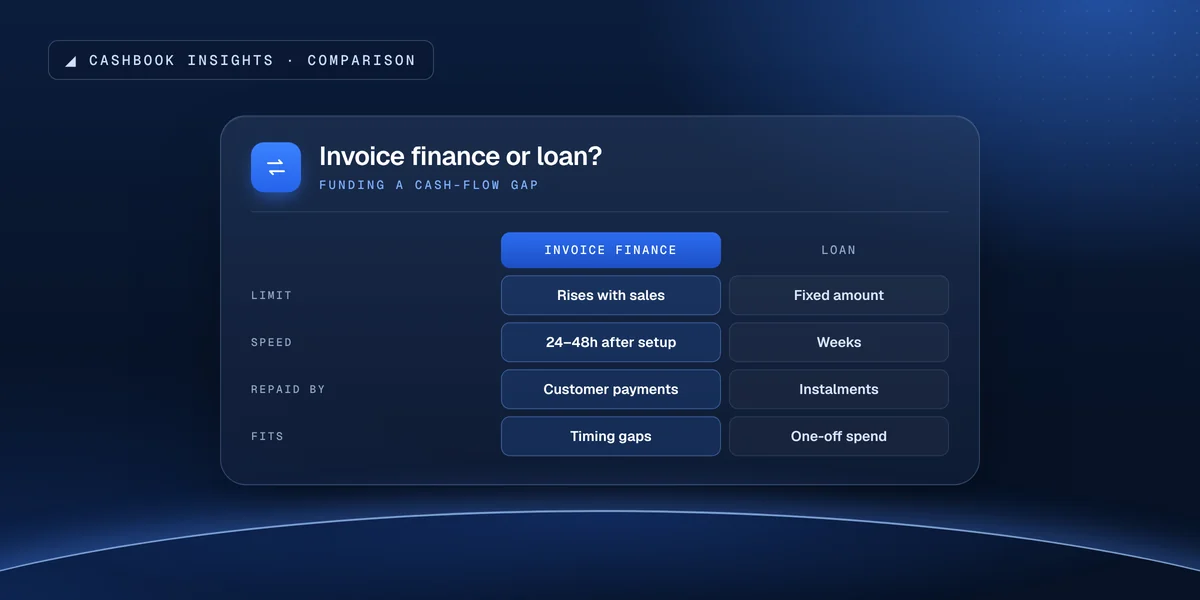
Decision guide
Invoice finance or a business loan: the practical difference.
Invoice finance funds approved B2B invoices and moves cash forward.
Customer receipts repay the facility as invoices settle.
Over-borrowing creates fixed pressure even when cash collection slows.
| Question | Usually stronger when | Watch-out |
|---|---|---|
| What is being funded? | Invoice finance funds approved B2B invoices and moves cash forward. | A loan may be better for a one-off purchase unrelated to customer invoices. |
| How repayment works | Customer receipts repay the facility as invoices settle. | Loan repayments are fixed regardless of whether customers pay late. |
| When it scales | It can grow with the invoice ledger if customers and evidence remain strong. | A loan has a fixed limit and may not flex with sales. |
| Main risk | Customer disputes, weak debtors or poor evidence can reduce availability. | Over-borrowing creates fixed pressure even when cash collection slows. |
Worked example
An invoice gap, two ways.
A firm needs about £35,000 for six weeks while a £40,000 invoice on 45-day terms is paid.
Invoice finance costs about £1,200 here and stops when the customer pays; a term loan would run for its full term.
| Invoice value, on 45-day terms | £40,000 |
|---|---|
| Advanced within 24–48 hours (90%) | £36,000 |
| Discount charge, about 2% per 30 days, for 45 days | £1,200 |
| Paid to you when your customer pays | £2,800 |
| Total cost of funding this invoice | £1,200 (3% of the invoice) |
| If your customer pays 15 days late | +£400 in charges |
Illustrative: up to 90% advanced and a discount charge of about 2% of the invoice per 30 days. Rates, advances and any service fee vary by business, sector and customers, and are confirmed in writing before you commit.
Decision framework
Invoice finance or a business loan: use the comparison to make a funding decision.
Choose between a revolving asset-linked facility and fixed-term borrowing.
Availability
Invoice finance can rise and fall with eligible invoices; a loan is a fixed principal amount.
Repayment
Invoice finance reduces as customers pay; a loan follows a scheduled repayment profile.
Control
Invoice facilities require ledger reporting and eligibility controls; loans may use covenants and fixed security.
Examples are educational only. Eligibility, pricing, security and final terms always depend on a formal assessment of your business, your documents and the facility proposed.
Can I have both?
Yes. Many businesses use invoice finance for the timing gap and a loan for a one-off investment.
Which is cheaper?
It depends on how long the money is used. Invoice finance charges for the days invoices are funded; a loan charges interest for its full term.
Does invoice finance need security?
The invoices are the main security; a debenture and guarantees are common. A loan may need other assets.
How fast is each?
Once set up, invoice finance can typically release funds within 24–48 hours of an invoice; loans are drawn once.
Next step
Ready to check the numbers on your case?
A director reviews every application and gives a first view within one working day.