

Is VAT charged?
VAT can apply where the seller has opted to tax or the building is new; a transfer of a going concern may mean no VAT at all.
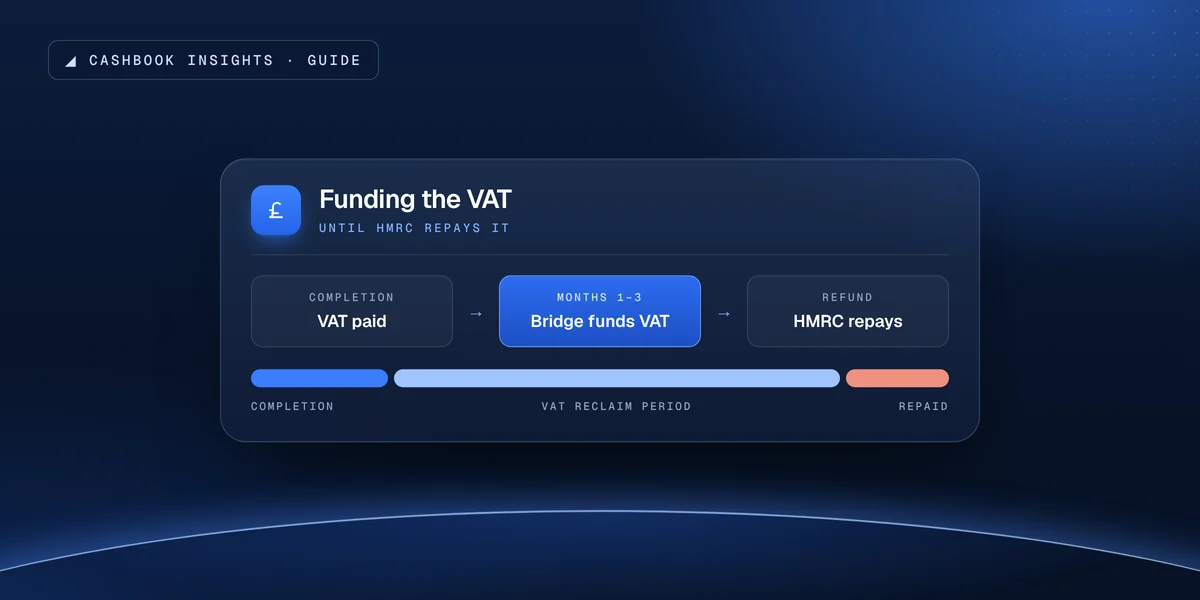
When a commercial property is sold with VAT charged (for example, where the seller has opted to tax), the buyer must pay VAT on top of the price at completion, even if they can reclaim it later. A VAT bridging loan is a short-term loan that funds that VAT until HMRC repays it, typically a few months later.
Bridging structure check
A £325,000 loan against a £500,000 property
Within a 70% illustrative LTV reference point.
A £325,000 loan against a £500,000 property is 65% loan-to-value; equity remaining £175,000.
Security risk: Your property may be repossessed if you do not keep up repayments on a loan secured against it.
The VAT element only works as a bridge if it will genuinely be recovered.
VAT can apply where the seller has opted to tax or the building is new; a transfer of a going concern may mean no VAT at all.
The buyer needs to be VAT-registered and, where needed, to have opted to tax so the VAT can be reclaimed.
Delays in registration or HMRC checks extend the loan and its cost.
When VAT is charged on a commercial property, the buyer pays it on top of the price at completion. A VAT bridge funds that amount until the reclaim is repaid, typically a few months later.
If the VAT cannot be recovered, or recovery is delayed, the bridge has no natural exit. That is why the VAT position needs confirming by your solicitor and tax adviser before terms are agreed.
Which suits you
| Your situation | Usually the better fit | Why |
|---|---|---|
| VAT charged, buyer registered and opted to tax | VAT bridge | The reclaim repays it |
| Sale is a transfer of a going concern | Probably no VAT to bridge | TOGC sales may be outside VAT |
| Buyer not yet VAT-registered | Register before completion | Delays push the repayment back |
| VAT not recoverable (exempt use) | No VAT bridge | There is no exit |
Worked example
A company buys a £1,000,000 commercial building on which VAT is charged at 20%. It is VAT-registered and expects HMRC to repay the £200,000 in about 4 months.
The VAT reclaim is the exit, so registration and the option to tax need to be in order before completion.
| VAT payable at completion (20%) | £200,000 |
|---|---|
| VAT bridge | £200,000 |
| Arrangement fee, 1% | £2,000 |
| Interest at 1% a month for 4 months | £8,000 |
| Repaid from the HMRC repayment | £208,000 |
| If HMRC repays 2 months later | +£4,000 in interest |
Illustrative: interest at 1% a month, rolled up, and an arrangement fee of 1% of the loan. Valuation and legal costs are extra and quoted per case. Bridging finance is secured against property, which may be repossessed if repayments are not maintained. Take tax advice on the VAT position.
The reclaim is the repayment route, so it has to be reliable.
VAT confirmed as payable on the purchase.
Registration and option to tax in place.
A realistic repayment date, with headroom.
Often a few weeks to a few months, depending on your return period and any checks. Plan with headroom.
Often yes; it can be a separate facility or part of the purchase loan.
A transfer of a going concern may mean no VAT is charged, so there may be nothing to bridge.
Yes, to reclaim the VAT. Registration and the option to tax should be in place before completion.
Official guidance and legislation on the rules this page refers to. They explain the rules in general; take advice on your own position.
Bridging delays usually come from unclear security, weak exit evidence or legal details that should have been surfaced before the deadline became urgent.
Next step
Share the purchase, the VAT treatment and your registration status, and we will give you a straight view on how the funding could be structured.