

Short-term, fast-moving property debt built around a defined exit route.
Funding comparison · decision guideFCA-registered UK lender FRN 782472 (opens the FCA register in a new tab)
Bridge or commercial mortgage?
Use bridging for speed and transition. Use a commercial mortgage for stable ownership once affordability and documentation are ready. This page compares short-term, exit-led property debt with longer-term affordability-led borrowing. The mistake to avoid is using a bridge for a long-term hold or forcing a mortgage into a deadline it cannot meet.
Read aloud by your browser
Bridging structure check
A £325,000 loan against a £500,000 property
65%
loan-to-value, against a 70% illustrative reference point
- Equity remaining
- £175,000
- Headroom to 70% LTV
- £25,000
Within a 70% illustrative LTV reference point.
A £325,000 loan against a £500,000 property is 65% loan-to-value; equity remaining £175,000.
Security risk: Your property may be repossessed if you do not keep up repayments on a loan secured against it.
Longer-term borrowing assessed around income, affordability and repayment capacity.
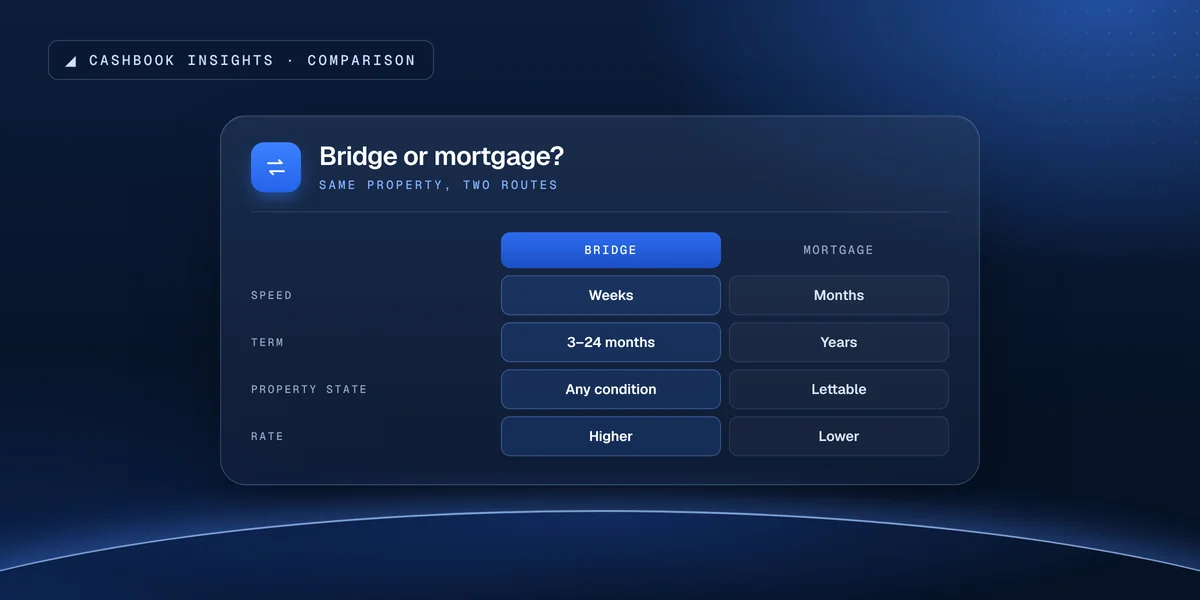
Use bridging for speed and transition. Use a commercial mortgage for stable ownership once affordability and documentation are ready.
Decision guide
Bridge or commercial mortgage: the practical difference.
The right comparison is not simply the lowest headline rate. Match the facility to the asset being funded, the evidence available, the expected duration, the operational work required and the event that repays it. A cheaper product used for the wrong job can create more delay, covenant pressure or refinancing risk than a correctly structured specialist facility.
Bridging is for short deadlines and transitional periods.
Security, valuation, legal route and exit dominate.
A mortgage may be too slow for auction or chain-break deadlines.
| Question | Usually stronger when | Watch-out |
|---|---|---|
| Time horizon | Bridging is for short deadlines and transitional periods. | Commercial mortgages suit long-term property ownership. |
| Decision basis | Security, valuation, legal route and exit dominate. | Affordability, income and longer-term servicing dominate. |
| Speed | A bridge can be faster if the file is clean. | Commercial mortgages usually take longer to underwrite. |
| Watch-out | Never use bridging as long-term debt by accident. | A mortgage may be too slow for auction or chain-break deadlines. |
Which suits you
Bridge or mortgage, by situation.
| Your situation | Usually the better fit | Why |
|---|---|---|
| Auction or chain-break deadline | Bridge | Speed; a mortgage may not complete in time |
| Long-term ownership with steady income | Commercial mortgage | Lower cost over years |
| Property not yet mortgageable (works, vacancy) | Bridge, then mortgage | Fix the issue, then refinance |
| No credible refinance or sale | Neither yet | A bridge needs a defined exit |
Worked example
A bridge, then a mortgage.
A business buys a £600,000 unit with a £390,000 bridge to meet a deadline, then refinances onto a commercial mortgage in month 6.
Used for six months the bridge does its job; left for years it would be the expensive way to own the building.
| Property value | £600,000 |
|---|---|
| Gross loan (65% loan-to-value) | £390,000 |
| Arrangement fee, 1%, from the loan | £3,900 |
| Interest at 1% a month, rolled up, for 6 months | £23,400 |
| Repaid at exit (loan plus interest) | £413,400 |
| Cost before valuation and legal fees | £27,300 |
| If the exit is 3 months late | +£11,700 in interest |
Illustrative: interest at 1% a month, rolled up, and an arrangement fee of 1% of the loan. Valuation and legal costs are extra and quoted per case. Bridging finance is secured against property, which may be repossessed if repayments are not maintained.
Decision framework
Bridge or commercial mortgage: use the comparison to make a funding decision.
Use a bridge for a short-term timing problem, not as a substitute for long-term affordability.
Speed
A bridge may complete faster when evidence and legal work are ready.
Term
Commercial mortgages are designed for longer-term ownership and scheduled repayments.
Exit
A bridge must repay from sale, refinance or another defined route within the term.
Examples are educational only. Eligibility, pricing, security and final terms always depend on a formal assessment of your business, your documents and the facility proposed.
Can a bridge be refinanced onto a commercial mortgage?
Yes, that is a common exit. Check early that the property and your income will meet the mortgage lender’s criteria.
Which is cheaper?
A commercial mortgage, over the long term. A bridge costs more per month but can be cheaper overall when it saves a deal or is used for a few months only.
How long does a bridge last?
Typically up to 12 months, sometimes longer. It is repaid in one payment at the exit.
Do I need accounts for a bridge?
The decision rests mainly on the property and the exit, but lenders still check the borrower and the people behind it.
Official sources
- Bank Rate (opens in a new tab)Bank of England
Official guidance and legislation on the rules this page refers to. They explain the rules in general; take advice on your own position.
Next step
Ready to check the numbers on your case?
A director reviews every application and gives a first view within one working day.