

The borrowing entity
Incorporation, ownership, filed accounts and Companies House records are reviewed.
Many property investors buy through a limited company, often a special purpose vehicle (SPV) set up only to hold property.
Bridging structure check
A £325,000 loan against a £500,000 property
Within a 70% illustrative LTV reference point.
A £325,000 loan against a £500,000 property is 65% loan-to-value; equity remaining £175,000.
Security risk: Your property may be repossessed if you do not keep up repayments on a loan secured against it.
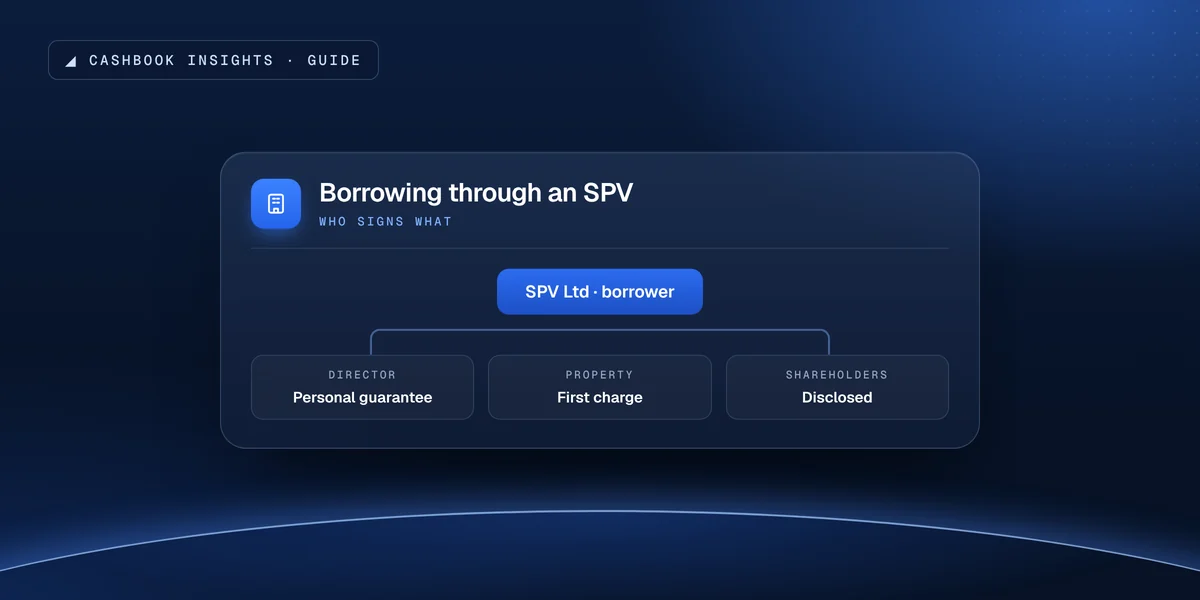
The company borrows, but directors and shareholders are checked and often asked to guarantee.Bridging lenders regularly lend to companies, but they look through the company to the people behind it: directors and shareholders are checked, and personal guarantees are commonly requested.
Incorporation, ownership, filed accounts and Companies House records are reviewed.
The identity, experience and credit history of the people with significant control.
Commonly requested from directors or shareholders, sometimes with independent legal advice.
Many investors hold property in an SPV for tax and financing reasons, on professional advice. Many longer-term buy-to-let lenders lend to SPVs, which can make a refinance exit easier.
If the plan is to refinance, check early that long-term lenders will lend to the same company on the expected terms, so the bridge can be repaid on time.
Which suits you
| Your situation | Usually the better fit | Why |
|---|---|---|
| Buying rental property through a new SPV | Company bridge, refinance to SPV buy-to-let | Exit available to the same company |
| Trading company buying its own premises | Company bridge or commercial mortgage | Depends on the timetable |
| The property will be a family home | Not a business bridge | That is regulated mortgage lending |
| Directors cannot give guarantees | Raise it at the start | Guarantees are commonly required |
Worked example
An SPV buys a £300,000 rental property with a £195,000 bridge and refinances onto a buy-to-let mortgage for the same company in month 6.
Confirm early that a long-term lender will lend to the same SPV, so the refinance can repay the bridge on time.
| Property value | £300,000 |
|---|---|
| Gross loan (65% loan-to-value) | £195,000 |
| Arrangement fee, 1%, from the loan | £1,950 |
| Interest at 1% a month, rolled up, for 6 months | £11,700 |
| Repaid at exit (loan plus interest) | £206,700 |
| Cost before valuation and legal fees | £13,650 |
| If the exit is 3 months late | +£5,850 in interest |
Illustrative: interest at 1% a month, rolled up, and an arrangement fee of 1% of the loan. Valuation and legal costs are extra and quoted per case. Bridging finance is secured against property, which may be repossessed if repayments are not maintained.
Most delays come from missing company paperwork rather than the property.
Clear ownership and control of the SPV.
Who will guarantee, and on what terms.
A refinance or sale available to the company.
Yes. Lenders look through the company to its directors and shareholders, so their experience and position matter.
Commonly, yes. You may be asked to take independent legal advice on it.
The certificate of incorporation, the articles, the register of people with significant control and ID for the directors and shareholders.
A new SPV will not have any. Lenders rely on the property, the exit and the people behind the company.
Official guidance and legislation on the rules this page refers to. They explain the rules in general; take advice on your own position.
Bridging delays usually come from unclear security, weak exit evidence or legal details that should have been surfaced before the deadline became urgent.
Next step
Share the SPV’s details, the property and the exit, and we will give you a straight view on fit.