

Use evidence, not aspiration
Purchase price, market value, investment value and a post-works estimate are different measures. The structure must use the basis relevant to the proposed security.
The valuation anchors the security analysis and can change the available facility. Access, title, condition, planning and comparable evidence all influence how quickly the report can support a decision.
Bridging structure check
A £325,000 loan against a £500,000 property
Within a 70% illustrative LTV reference point.
A £325,000 loan against a £500,000 property is 65% loan-to-value; equity remaining £175,000.
Security risk: Your property may be repossessed if you do not keep up repayments on a loan secured against it.
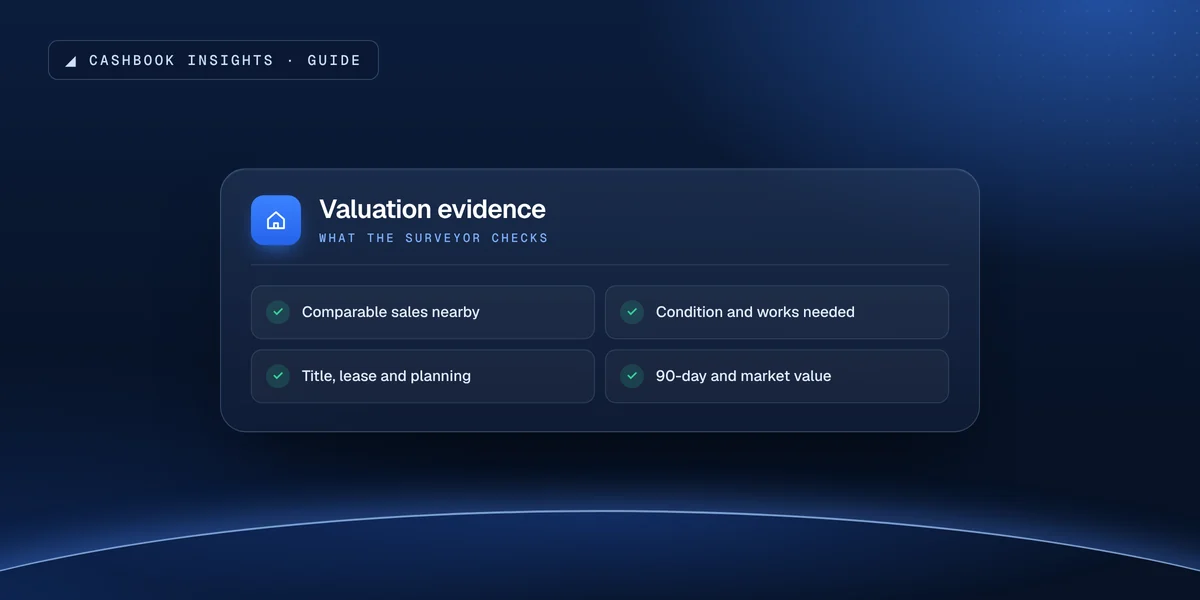
A strong application makes the property easy to inspect and the relevant facts easy to verify.
Purchase price, market value, investment value and a post-works estimate are different measures. The structure must use the basis relevant to the proposed security.
Occupancy, disrepair, non-standard construction, planning, licensing and environmental issues can affect value, marketability and lender appetite.
Confirm access, contacts, leases, plans and property documents before instruction. A fast valuation cannot compensate for missing information.
A valuation is commissioned for the lender’s security decision. It may not adopt the borrower’s estimate or the price agreed between connected parties. The report can also identify legal, planning, condition or marketability points that need further work.
Borrowers can reduce friction by providing accurate property details, immediate access, tenancy and planning information, a schedule of works where relevant and evidence supporting the proposed exit. Hiding a weakness usually creates a later delay rather than a better outcome.
Which suits you
| Your situation | Usually the better fit | Why |
|---|---|---|
| The price was agreed between connected parties | Expect a full independent valuation | Connected prices are not relied on |
| The property is tenanted | Send leases and the rent schedule | Tenancies affect value and access |
| Works are planned | Send the schedule of works and costs | Supports a value after works |
| The deadline is tight | Book access before instruction | Access is the most common avoidable delay |
Worked example
A buyer agrees £400,000 and plans to borrow 70%. The lender’s valuation comes in at £370,000.
Keep a cash buffer or a fallback for a low valuation before you commit to a deadline.
| Agreed price | £400,000 |
|---|---|
| Loan expected at 70% of the price | £280,000 |
| Lender’s valuation | £370,000 |
| Loan available at 70% of the valuation | £259,000 |
| Shortfall the buyer must fund | £21,000 |
Illustrative: lending is sized on the lender’s valuation, not the agreed price, at an illustrative 70% reference loan-to-value. Bridging finance is secured against property, which may be repossessed if repayments are not maintained.
The valuation protects the lender and tests the assumptions behind the exit.
The value in the property’s present condition.
A shorter marketing period may produce a lower figure.
Relevant only where works and planning support a credible completed value; it is not the same as current security value.
The borrower usually pays, and the valuer reports to the lender. The cost is quoted before instruction.
Often days once access is booked; complex or tenanted property takes longer.
The lender instructs its own valuer, but your evidence (comparables, plans, leases) helps the report.
The loan reduces, or you add equity. You can challenge it with evidence, but plan for the possibility.
Official guidance and legislation on the rules this page refers to. They explain the rules in general; take advice on your own position.
Bridging delays usually come from unclear security, weak exit evidence or legal details that should have been surfaced before the deadline became urgent.
Next step
Prepare access, title, tenancy, planning and works information before the valuer is instructed.