

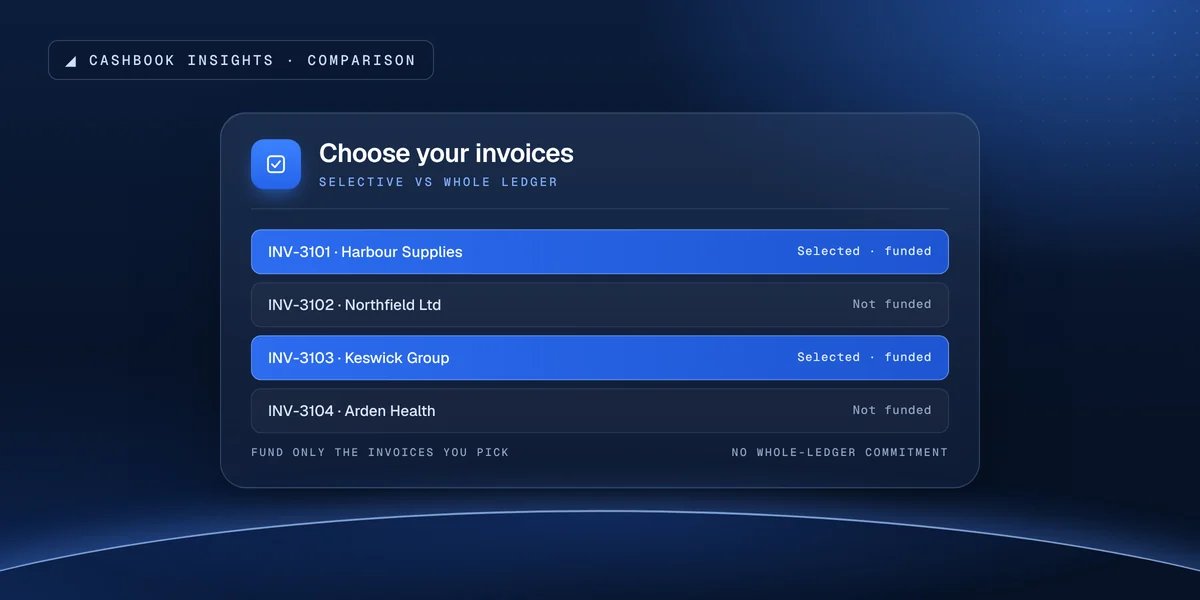
Funds chosen invoices when you need cash without committing the whole debtor book.
Funding comparison · decision guideFCA-registered UK lender FRN 782472 (opens the FCA register in a new tab)
Selective vs full-ledger funding.
This is a choice between solving a specific invoice gap and installing an ongoing working-capital facility. The right answer depends on how often the gap repeats and how much of the debtor book you want inside the facility.
Read aloud by your browser
Cash received · this invoice
A £50,000 invoice on 30-day terms
- Invoice value
- £50,000
- Paid to you, day 1–2
- £45,000
- When your customer pays
- £4,000
On a £50,000 invoice on 30-day terms: £45,000 advanced at 90%, £4,000 when your customer pays, a fee of about £1,000.
Illustrative: a 90% advance and a discount charge of about 2% of the invoice. Rates and advances vary by business, sector and customers.
Check eligibilityFunds across the debtor ledger as an ongoing working-capital structure.
Use selective finance for occasional pinch points. Use full-ledger funding when invoice timing is a recurring constraint.
Decision guide
Selective or full-ledger funding: the practical difference.
Selective funding targets one or a small number of invoices.
Useful for a specific large invoice or short-term timing gap.
A full facility may be excessive where the need is genuinely occasional.
| Question | Usually stronger when | Watch-out |
|---|---|---|
| Scope | Selective funding targets one or a small number of invoices. | Full-ledger funding works across the wider debtor book. |
| Best use | Useful for a specific large invoice or short-term timing gap. | Useful where credit terms regularly stretch working capital. |
| Admin | Usually narrower information around the selected invoices. | Requires broader ledger reporting and ongoing discipline. |
| Watch-out | Repeated one-off use can signal that a full facility is more honest. | A full facility may be excessive where the need is genuinely occasional. |
Worked example
One invoice, funded on its own.
A business funds a single £60,000 invoice to a large customer on 60-day terms and leaves the rest of its ledger alone.
You pay only for the invoice you choose; if you would fund every month, a full-ledger facility is usually cheaper.
| Invoice value, on 60-day terms | £60,000 |
|---|---|
| Advanced within 24–48 hours (90%) | £54,000 |
| Discount charge, about 2% per 30 days, for 60 days | £2,400 |
| Paid to you when your customer pays | £3,600 |
| Total cost of funding this invoice | £2,400 (4% of the invoice) |
Illustrative: up to 90% advanced and a discount charge of about 2% of the invoice per 30 days. Rates, advances and any service fee vary by business, sector and customers, and are confirmed in writing before you commit.
Decision framework
Selective or full-ledger funding: use the comparison to make a funding decision.
Decide whether the need is genuinely occasional or part of the normal working-capital cycle.
Scope
Selective finance funds chosen invoices; full-ledger finance supports a broader revolving pool.
Cost pattern
Selective use can be more expensive per invoice; full-ledger facilities may include minimums and ongoing fees.
Suitability
Selective works best for isolated high-quality debts; recurring pressure usually points to a whole-ledger review.
Examples are educational only. Eligibility, pricing, security and final terms always depend on a formal assessment of your business, your documents and the facility proposed.
Is selective finance more expensive?
Per invoice it can be, but there are no minimums or whole-ledger fees. Over many invoices a full facility is usually cheaper.
Can I switch later?
Yes. Many businesses start with selective finance and move to a full facility as the need becomes regular.
Will my customer know?
Usually the funded invoice is disclosed to that customer. Ask if confidentiality matters.
How quickly is a selected invoice funded?
Once approved, typically within a day or two.
Next step
Ready to check the numbers on your case?
A director reviews every application and gives a first view within one working day.