

Supply chain finance vs invoice finance
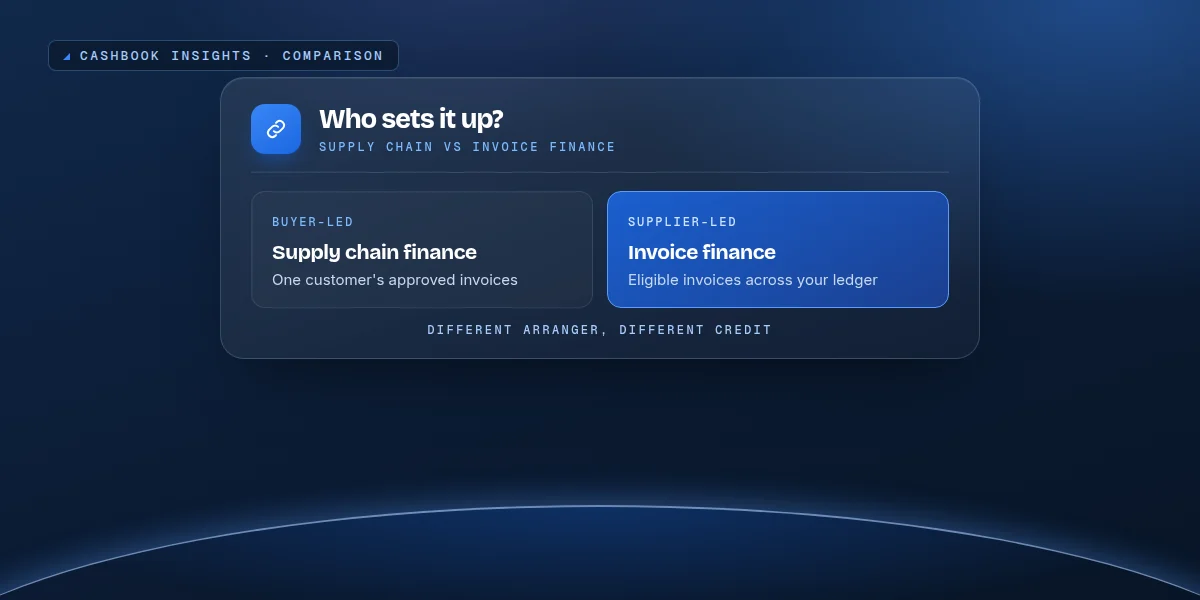
Supply chain finance (also called reverse factoring) is set up by a large buyer so its suppliers can be paid early, based on the buyer's credit strength. Invoice finance is arranged by the supplier itself, against its own invoices to many customers. If your customer offers a supply chain finance programme it can be cheap money; if not, invoice finance is the route you control.
How each works
Supply chain finance
- A large buyer approves your invoice for payment.
- A bank or platform offers to pay you early, less a discount.
- The buyer pays the funder on the original due date.
Invoice finance
- You raise invoices to your customers.
- A funder advances a percentage of eligible invoices - up to 90% at Cashbook Finance, after approval and setup.
- The balance, less fees, follows when your customers pay.
Side by side
| Supply chain finance | Invoice finance | |
|---|---|---|
| Who arranges it | The buyer | Your business |
| Whose credit it relies on | The buyer's | Your customers' and your business's |
| Which invoices | Only that buyer's approved invoices | Eligible invoices across your ledger (or selected ones) |
| Cost | Often low, reflecting the buyer's credit | Reflects your ledger, customers and service level |
| Control | Set by the buyer's programme | Set by your facility |
Which to use
- If a major customer offers a programme, it can be worth joining for that customer's invoices.
- For the rest of your ledger, or if no programme exists, invoice finance gives you funding you control.
- If you need to pay suppliers before you can invoice, look at trade finance - compared in trade finance vs invoice finance.
A practical decision test
The question is not which product is better but which invoices each can fund. A buyer's programme covers that buyer only; invoice finance covers the ledger you choose.
Commercial fit
Join a buyer's programme where it is offered and good value; use invoice finance for every other customer.
Evidence and eligibility
Supply chain finance relies on the buyer approving each invoice; invoice finance looks at your customers, ledger quality and controls.
Operational fit
Check whether a programme restricts assigning that buyer's invoices elsewhere, so the two arrangements do not conflict.
Alternatives
Trade finance for paying suppliers before you can invoice; selective invoice finance for occasional large invoices.
Model the downside, not just the headline
Model your cash flow if the buyer changes or withdraws its programme; funding that depends on one customer's choice can disappear at short notice.
Where this can go wrong
Joining a programme can tie a large customer's invoices to one funder. Make sure an existing or planned invoice finance facility can exclude them cleanly.
Questions to ask before signing
- Which customers' invoices would each arrangement cover?
- Does the buyer's programme restrict assigning its invoices elsewhere?
- What does early payment cost compared with an invoice finance advance?
- What happens if the programme ends?
Documents and controls to prepare
Every invoice finance discussion goes better with the same core pack: a current aged-debt report, representative contracts and invoices with delivery or acceptance evidence, recent management accounts with a short cash forecast, and an honest schedule of credit notes, bad debts and customer concentration. We keep one maintained resource covering the full pack, the questions that surface the all-in cost, and what to monitor once a facility is live - read the invoice finance preparation checklist.
This guide is general information, not a recommendation or an offer of finance.
See what your invoices could release
Tell us how your business invoices and a director will give you a straight, no-obligation view on fit - usually within a day or two.
Talk to us →