

Invoice finance for construction: CIS, retentions and applications for payment
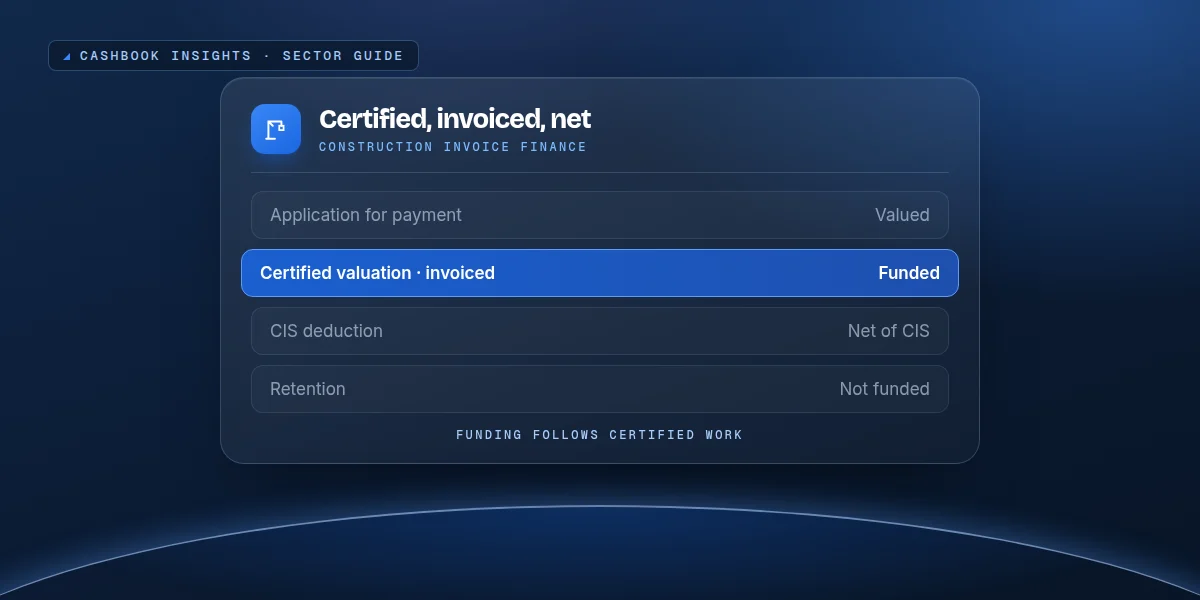
Construction businesses can use invoice finance, but funders look closely at how the money is earned. Funding is usually based on work that has been certified and invoiced, net of CIS deductions, with retentions and disputed amounts left out. Selective funding of individual certified invoices is often a better fit than a whole-ledger facility.
Why construction is different
In most sectors an invoice is a straightforward claim for goods or services delivered. In construction, payment often depends on:
- Applications for payment that the main contractor or client may reduce when they value the work;
- Certification of the work by a surveyor or contract administrator;
- Pay less notices and contra-charges, which can reduce what is actually paid;
- Retentions held back until practical completion and the end of the defects period;
- CIS deductions taken at source from payments to subcontractors.
Each of these makes the final amount less certain than the invoice suggests, which is why funders adjust.
What funders usually lend against
- Certified, invoiced work for creditworthy clients, rather than applications that have not yet been valued.
- The net amount you will actually receive: CIS deductions and agreed discounts come off before an advance is calculated.
- Not retentions, which are typically excluded until they are released and invoiced.
- Not disputed or contra-charged amounts.
Whole ledger or selective?
Many contractors invoice a small number of clients in large amounts, and some contracts carry more risk than others. Selective invoice finance lets you fund chosen certified invoices instead of the whole ledger. Compare the two in selective vs full-ledger invoice finance.
What to prepare
- Contracts or subcontract orders, including payment and retention terms;
- Recent applications, valuations or certificates, and the invoices raised against them;
- An aged debtor report and a list of any disputes, contra-charges or pay less notices;
- CIS statements and evidence of your CIS status;
- Management accounts and a short cash-flow forecast.
The invoice finance preparation checklist covers the general pack.
Common reasons construction applications stall
- Heavy reliance on one main contractor;
- Large unagreed variations or frequent contra-charges;
- Funding requested against applications that have not been certified;
- Retentions counted as available funding.
See also why invoice finance applications are declined and the construction sector page.
A practical decision test
The test for construction funding is how certain each payment is. Certified, invoiced work for creditworthy clients funds well; applications, retentions and disputed amounts do not.
Commercial fit
Best for contractors with certified work, reliable payers and a spread of clients rather than one dominant main contractor.
Evidence and eligibility
Expect funders to check contracts, certificates, payment notices and the history of contra-charges before setting availability.
Operational fit
Submit applications and invoices promptly, keep certification paperwork tidy and track pay less notices as they arrive.
Alternatives
Selective funding of individual certified invoices, trade finance for materials, or better payment terms can fit where whole-ledger funding does not.
Model the downside, not just the headline
Model availability using only certified, invoiced, net-of-CIS amounts, then stress it for a reduced valuation or a delayed certificate on your largest contract.
Where this can go wrong
Counting applications or retentions as fundable cash leads to shortfalls. A contra-charge or pay less notice late in a contract can reverse funding you had planned around.
Questions to ask before signing
- Will you fund against certified valuations only, or also against applications?
- How are CIS deductions and retentions treated in the calculation?
- What happens to funding if a client issues a pay less notice?
- Can individual contracts or invoices be funded selectively?
Documents and controls to prepare
Every invoice finance discussion goes better with the same core pack: a current aged-debt report, representative contracts and invoices with delivery or acceptance evidence, recent management accounts with a short cash forecast, and an honest schedule of credit notes, bad debts and customer concentration. We keep one maintained resource covering the full pack, the questions that surface the all-in cost, and what to monitor once a facility is live - read the invoice finance preparation checklist.
This guide is general information, not a recommendation or an offer of finance.
See what your invoices could release
Tell us how your business invoices and a director will give you a straight, no-obligation view on fit - usually within a day or two.
Talk to us →