

Bridging finance terms, explained in plain English
Bridging finance has its own vocabulary, and the terms in a quote decide how much is released and what is repaid. Here are the ones that matter, from loan-to-value and retained interest to open and closed bridges and the exit.
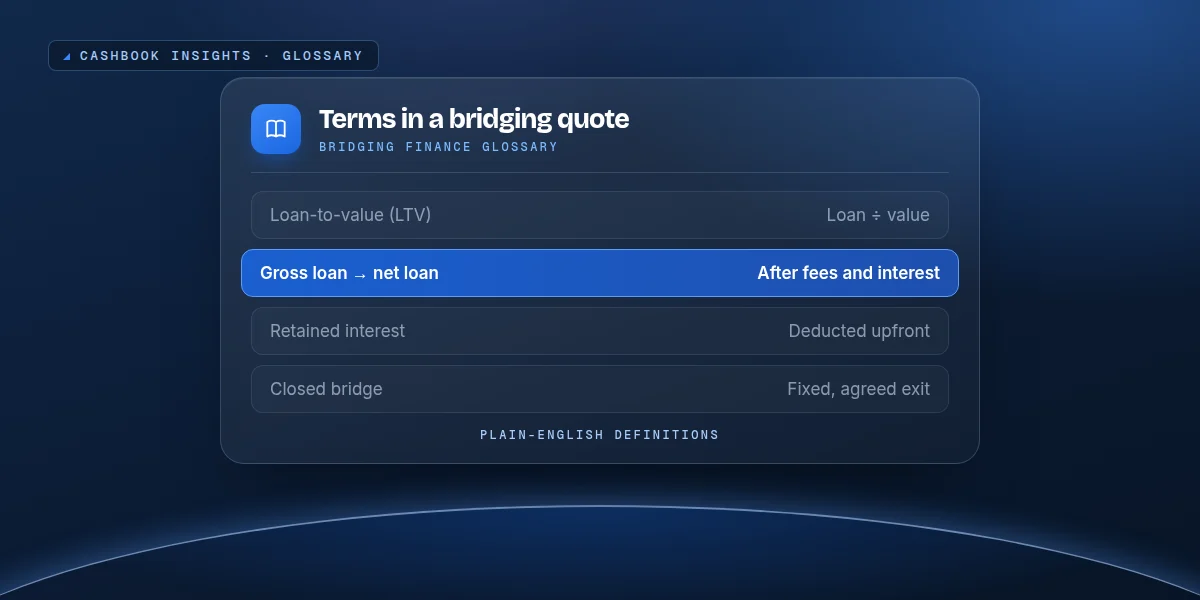
The essentials
- Bridging loan - a short-term loan secured on property, usually for months rather than years, repaid by a sale or a refinance.
- Loan-to-value (LTV) - the loan as a percentage of the property's value; check whether a lender calculates it on the gross or the net loan. Read the guide.
- Gross loan - the total borrowed, including any fees and interest added to the loan.
- Net loan - the amount actually released at completion, after fees and any retained interest are deducted.
- Exit - how the loan will be repaid, usually by selling the property or refinancing onto longer-term finance. Read the guide.
- Term - the agreed length of the loan; repayment is due at the end even if the exit is delayed.
- Security - the property charged to the lender, which can be sold if the loan is not repaid.
Interest and fees
- Monthly interest rate - bridging interest is usually quoted per month rather than per year.
- Retained interest - interest for some or all of the term deducted from the loan at the start, so no monthly payments are made.
- Rolled-up interest - interest added to the loan balance each month and repaid with the loan at the end.
- Serviced interest - interest paid monthly by the borrower during the term.
- Arrangement fee - the lender's fee for setting up the loan, often a percentage of the loan, usually added to it or deducted at completion. Read the guide.
- Exit fee - a fee some lenders charge when the loan is repaid; not every loan has one.
- Valuation fee - the cost of the lender-instructed valuation, usually paid by the borrower before the offer.
- Legal fees - the borrower's own solicitor costs and, usually, the lender's legal costs, both paid by the borrower.
Property, charges and process
- First charge - the main legal charge over a property; the first-charge lender is repaid first from a sale.
- Second charge - a charge behind an existing mortgage, repaid only after the first charge, so lenders usually lend less against it.
- Open bridge - a bridge whose exit is planned but not yet fixed, such as a property still to be sold; lenders look closely at how realistic the exit is.
- Closed bridge - a bridge with a fixed, agreed exit, such as an exchanged sale with a completion date.
- Valuation - the lender-instructed assessment of the property's value, usually by a RICS surveyor; the loan is sized against it. Read the guide.
- Gross development value (GDV) - the estimated value of a property once the planned works are complete.
- Light refurbishment - works without structural change, planning permission or change of use, such as new kitchens, bathrooms and decoration. Read the guide.
- Heavy refurbishment - works involving structural change, planning permission or a change of use. Read the guide.
- Staged drawdown - funds for works released in tranches as each stage is completed and checked, rather than all at once.
- Chain break - a gap in a property chain, for example when a buyer pulls out; a bridge can fund the purchase until the sale completes.
- Auction completion - the deadline to complete after a successful auction bid, commonly 28 days from exchange. Read the guide.
- Redemption statement - the lender's statement of the exact amount needed to repay the loan on a given date.
Borrowers and regulation
- Business bridging - bridging for business or investment purposes, secured on commercial or investment property; this is the bridging Cashbook Finance provides.
- Regulated bridging loan - a bridge secured on a home the borrower or a close family member lives in or will live in, regulated by the FCA; Cashbook Finance does not provide these. Read the guide.
- Personal guarantee - a director's or shareholder's personal promise to repay if the borrowing company cannot. Read the guide.
- Special purpose vehicle (SPV) - a limited company set up only to hold property. Read the guide.
- VAT bridging loan - short-term funding for the VAT due on a commercial property purchase, repaid when HMRC refunds it. Read the guide.
Knowing these makes comparing bridging offers far easier - and if a lender cannot explain a charge in plain terms, that tells you something too. For invoice finance terms, see the invoice finance glossary.
A practical decision test
Terms matter because they change the numbers. Whether a quoted LTV is on the gross or the net loan, whether interest is retained or serviced, and whether there is an exit fee all change how much is released and what is repaid. Tie every definition to the offer and a worked example.
Net release
Ask for the amount released at completion after fees and any retained interest, and check it covers the purchase, the deposit gap or the works.
LTV basis
Check whether the LTV is calculated on the gross or the net loan, and on which valuation: purchase price, open-market value or value after works.
Total repayable
Add interest for the full term to the arrangement, valuation, legal and any exit fees. Compare offers on the total, not the monthly rate.
Exit evidence
Know what the lender needs to see for the sale or refinance, and when, so the exit is evidenced before the term starts to run.
Model the downside, not just the headline
Model the cost if the exit takes three months longer than planned: extra interest, any extension or default charges, and whether retained interest runs out before the loan is repaid.
Where this can go wrong
A low monthly rate can hide a higher total cost once fees, retained interest and an exit fee are added. Do not rely on a verbal summary: make sure the LTV basis, interest method, fees and term are explicit in the offer.
Questions to ask before signing
- Is the LTV calculated on the gross or the net loan?
- How much will be released at completion?
- Is interest retained, rolled up or serviced, and for how many months?
- What happens if the exit is delayed beyond the term?
Documents and controls to prepare
Every bridging discussion goes better with the same core pack: the property address and title details, the purchase or refinance figures, a schedule of works if there are any, the exit plan with its evidence (a sale strategy or a refinance agreement in principle), and identification for the borrowers and any guarantors. Most delays come from gaps in that pack - read what slows down bridging completion.
This guide is general information, not a recommendation or an offer of finance. Bridging finance is secured against property. Your property may be repossessed if you do not maintain repayments on a loan secured against it.
Talk through your bridging case
Tell us about the property, the amount and the exit, and a director will give you a straight, no-obligation view on fit - usually within a day or two.
Talk to us →