

Affiliate programme · invoice & bridging finance

Refer funding opportunities — earn a defined 20%.

For accountants, brokers, advisers, solicitors, estate agents and professional networks.Introduce businesses that need working-capital support through invoice finance,or property-backed short-term funding through bridging finance. We assess fit quickly,keep you informed and pay 20% of Cashbook Finance’s net income received on completion,subject to the written introducer terms agreed for the referral.

20%
Cashbook Finance’s net incomereceived on completion
Keepthe client
Direct access to anamed director
~48 hrs
Fast, honestfit assessment
£10k–£1m
Invoice & bridgingFCA reg. 782472
The proposition

You bring the relationship. We do the heavy lifting.

Cashbook Finance supports two clear funding needs.
Invoice finance releases cash tied up in unpaid B2B invoices, while bridging finance provides
short-term property-backed funding for purchases, refinancing, refurbishment and time-sensitive transactions.
Your client gets a direct, commercial assessment; you stay informed throughout and are paid on completion.

Value on both sides

Good for your client. Good for you.

What your client gains

Drawdown after setupAn eligible approved invoice can typically release up to 90%, subject to the agreed facility.
Funding that scales with salesMore invoicing, more headroom — no re-application.
No monthly repaymentsCustomers' payments settle the advances.
Often viable with no property to pledgeBuilt on the debtor book, not bricks and mortar.
Optional credit control & bad-debt protectionTake the admin and the risk off their plate.

What you gain

20% of Cashbook Finance’s net income received on completionThe basis and payment terms are confirmed in writing for the referral.
You keep the relationshipYour client deals with a named director, not a call centre.
You arrive with the answerExactly when the overdraft talk starts.
Almost no workA few lines is enough — we assess fit.
Marketing supportAn introducer pack plus a client-ready handout.
Two specialist routes

Match the funding problem to the right solution.

Working capital

Invoice finance

Convert completed B2B sales into working capital at the pace the business needs. Eligible invoices release cash early, helping fund payroll, suppliers and growth without waiting for customer payment terms to expire.

  • Advance up to 90% of eligible invoices
  • Funding can grow with the sales ledger
  • Selective, disclosed and confidential routes
  • Optional credit control and bad-debt protection
Explore invoice finance
Property-backed funding

Bridging finance

Move quickly on a property-led opportunity with short-term funding structured around the asset, the transaction and the exit. Suitable for acquisitions, refinances and refurbishments where timing matters and the repayment route is clear.

  • First- and second-charge structures considered
  • Buy-to-let, unoccupied residential investment, commercial and land security
  • Initial fit review, followed by valuation, legal work and evidence-led completion
  • Exit by sale, refinance or another evidenced route
Explore bridging finance
Free introducer resource

Explain invoice finance with confidence.

Download the practical presentation built for professional networks. It explains the product in plain English, shows where it fits and gives you a sharper way to recognise and refer opportunities.

  • Plain-English mechanics
  • Opportunity signals
  • Referral conversation toolkit
Download the presentationPDF · 2.9 MB
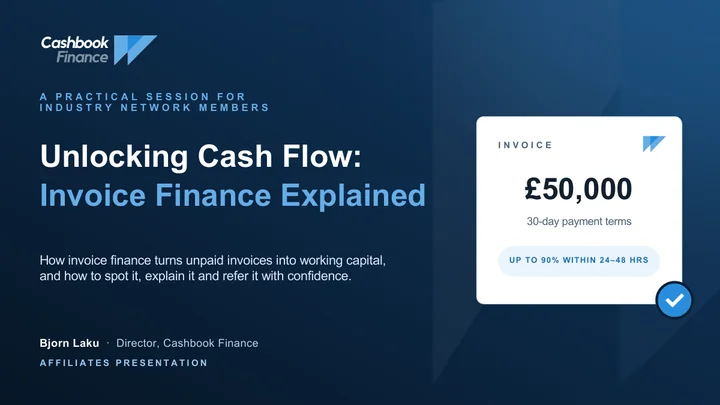
Cover of Unlocking Cash Flow: Invoice Finance Explained
Spot the opportunity

Do you have clients who need…

Wait 30–90 days to be paid by other businesses
Have just won a big contract they need to fund
Find payroll tight, even with a full order book
Were turned down by the bank — "not enough security"
Are growing faster than their cash can keep up
Have turned down work because the cash wasn't there
Short-term property funding for a purchase, refinance or refurbishment
A fast bridge while a sale, refinance or longer-term facility completes
Two or more?That's a conversation worth introducing.
The ideal client, in five checks
  • Sells B2B on credit terms — 14 to 120 days
  • Invoices after delivery or completion
  • Creditworthy customers — a spread, not one dominant payer
  • Clean paperwork — order → delivery → invoice
  • Growing, seasonal, or cash-tight despite profit

Typically £50k+ turnover and 6+ months trading. Best-fit sectors: recruitment, healthcare, haulage & logistics, wholesale & distribution, manufacturing, exporters, printing & packaging and professional services. Construction is fundable but specialist — refer for review, never rule out.

One screening question does most of the work:
"Do you invoice other businesses — and then wait to be paid?"

How to refer

Three simple steps.

1

Spot it

Hear one of the trigger phrases in a conversation you're already having? Think Cashbook. Listen for "can we extend the overdraft?", "we've just won a big contract", "payroll week is always tight", "the bank said no — not enough security", or "we're juggling the VAT and the suppliers".

2

Introduce

Email or call a director with a few lines: client, sector, rough turnover, who they invoice, payment terms and what prompted it. No obligation for you or the client.

A few lines is enough
3

We take it from there

A quick, honest initial view on fit, followed by due diligence, documentation and any required verification. Drawdown timing starts only after the facility is approved and set up. You are kept informed throughout and commission is paid on completion.

Affiliate FAQs

Answers to the common questions.

Quite the opposite — it's growth finance. Funders want healthy ledgers, and fast-growing firms are the heaviest users, because growth is exactly when the cash gap bites hardest.
It's structurally different: no lump sum and no monthly repayments. The client's sales create the funding; their customers' payments settle it. On cost, it's typically dearer than secured bank debt — the honest comparison is like-for-like, including the value of any credit control.
Invoice discounting is usually confidential — customers see no change. Disclosed factoring is also routine: large customers process Notices of Assignment every day.
Facilities run from single-invoice level upwards — typically suiting businesses with £50k+ annual turnover and 6+ months trading. Selective funding is a low-commitment way to start.
Standard facilities are "with recourse" — if an invoice is still unpaid after an agreed period (commonly ~90–120 days past due), the advance on that invoice reverses. Optional bad-debt protection adds cover if a customer becomes insolvent.
Fundable, but specialist — applications for payment, retentions and contract terms need the right product. Refer for specialist review rather than ruling it out.
You earn 20% of Cashbook Finance’s net income received on completion, subject to the written introducer terms agreed for the referral. You are kept informed throughout.
A straightforward commercial introduction may not require separate authorisation from the FCA, but the position depends on the activity, client and product. Introducers should confirm their own regulatory and professional obligations before referring business.
Just a few lines: the client's name, sector, rough turnover, who they invoice, their typical payment terms, and what prompted the conversation. We'll come back quickly with an honest view on fit.
Our focus is invoice finance, but if a client also needs short-term bridging secured on property, we're happy to review that too — so you can bring us the cash-flow conversation in whatever form it arises.
Verified partner testimonials

What professional partners say about the introducer experience.

Commercial finance broker
“Cashbook Finance gives us clear feedback on whether a case fits, what information is missing and what could prevent it from progressing. That direct approach helps us manage client expectations and avoids wasting time on structures that are not viable.”
Director, UK Commercial Finance Brokerage
Accountant and business adviser
“The team considers the underlying commercial position, not just the immediate funding request. Their feedback on debtor quality, cash-flow timing and the proposed repayment route has been useful when helping clients evaluate their options.”
Partner, UK Accountancy and Advisory Practice
Tracked introducer route

Introduce the opportunity.Keep the relationship.

Send the commercial context once. A named director reviews it before any client approach.

01
Submit the contextRequirement, route, timing and available evidence.
02
Director reviewWe assess likely fit and contact you first.
03
Stay in the loopYour attribution and client relationship remain visible.
Tracked attributionNo sensitive filesDirector-reviewed
Secure introduction

Referral details

Usually under 3 minutes
Your details
Client opportunity

Do not include identity documents, bank details or other sensitive files. A secure route will be confirmed if documents are needed.

Make your first referral

Bring us one client conversation, that's the whole ask.

20% of Cashbook Finance’s net income received on completion, subject to written introducer terms.
Introduce a client by contacting either director directly — we'll come back with a quick, honest view on fit.

Before introducing commercial finance, confirm the requirements of your professional body,network or regulator, including any duty to disclose introducer commission to the client.Invoice finance is not suitable for every business; suitability depends on the business model,invoice quality, debtor profile, contract terms, cost and funding requirement.All figures are illustrative; actual advance rates and pricing vary.